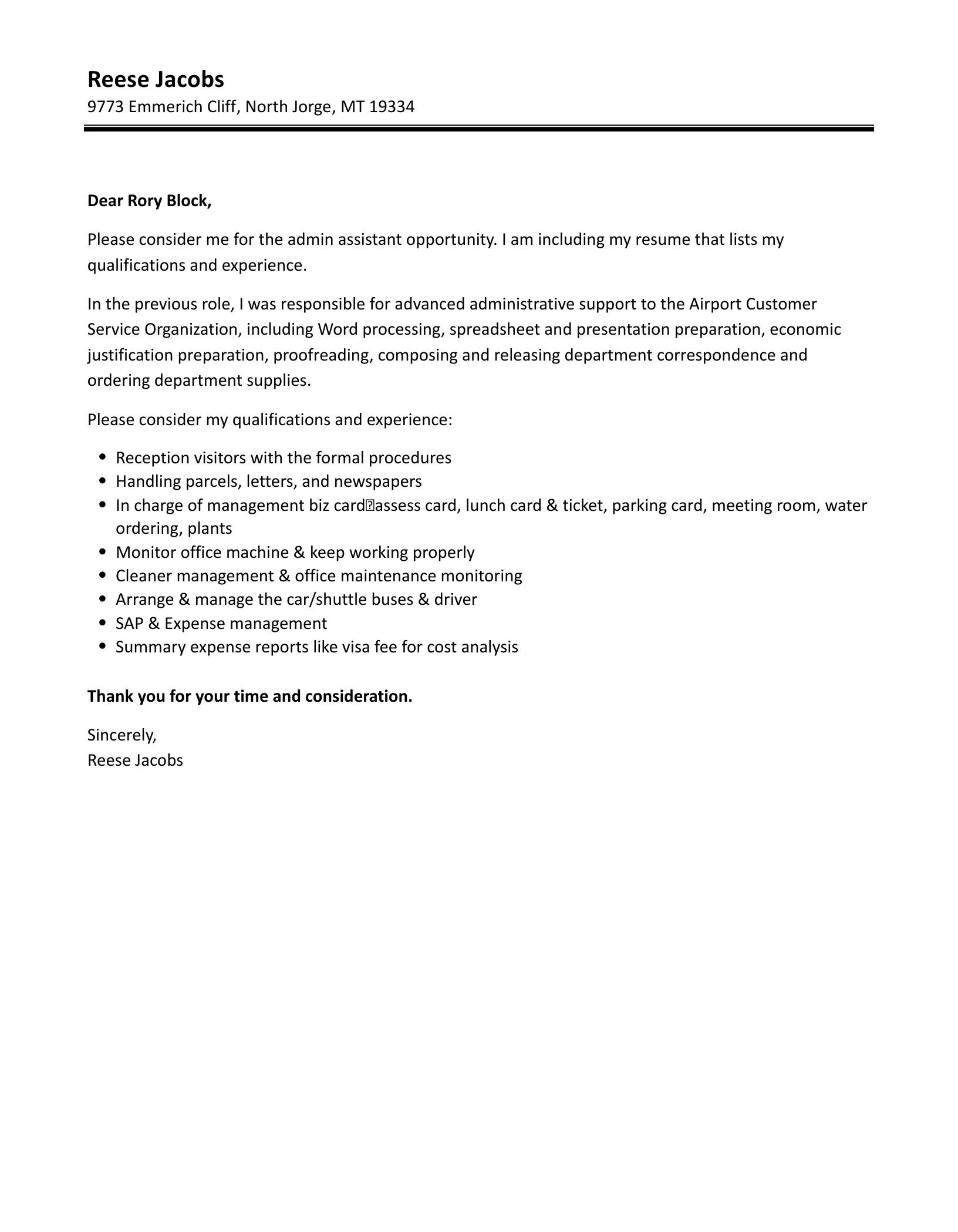
Why Admin Cover Letters Matter
In the competitive job market, especially for administrative roles, a well-crafted cover letter can be the key to unlocking your dream job. It’s more than just a formality; it’s your first opportunity to make a lasting impression on a potential employer. The cover letter is your chance to go beyond your resume, providing a narrative that showcases your personality, enthusiasm, and suitability for the specific role. It allows you to connect your skills and experience to the job requirements and demonstrate a genuine interest in the company. Without a compelling cover letter, your application might easily be overlooked, leaving you at a disadvantage in a highly competitive field. The cover letter is your chance to shine and prove why you are the best candidate.
Understanding the Purpose of an Admin Cover Letter
The primary purpose of an administrative cover letter is to introduce you and your qualifications to a hiring manager or employer. It’s a formal introduction that complements your resume, adding context and personality to your professional profile. Unlike a resume, which lists your experiences and skills, the cover letter allows you to articulate why you are the ideal candidate for the specific position. It should explain your understanding of the role, highlight the relevant skills and experience, and showcase your enthusiasm for the company and the job. Furthermore, a cover letter helps you to personalize your application and demonstrate your communication skills, which are crucial for administrative positions. It’s an opportunity to demonstrate your attention to detail, organizational skills, and professional writing abilities.
Key Elements of a Strong Admin Cover Letter

A successful administrative cover letter is more than just a document; it’s a persuasive sales pitch. To make yours stand out, focus on several key elements. Start with a professional header including your contact information and the date. Follow this with a personalized greeting. The body of your letter should highlight relevant skills and experiences, showing how they align with the job description. Use action verbs to describe your accomplishments and quantify them whenever possible. Tailor your letter to the job by researching the company and the specific role, demonstrating your understanding of their needs. Finally, format your letter for readability, proofread carefully, and end with a confident closing. Each section of your cover letter should build a narrative of your qualifications and fit for the role.
Header and Contact Information
The header of your administrative cover letter sets the first impression and provides essential contact information. Start by including your full name, address, phone number, and professional email address. Ensure your email address is appropriate and professional. Below your contact information, include the date. Then, if you know the hiring manager’s name, address your letter to them; otherwise, use a general greeting. Maintaining a clean, well-formatted header is critical for demonstrating your attention to detail and professionalism from the start. This section is your initial introduction, so make it clear, accurate, and easy for the employer to contact you. A properly formatted header signals that you are organized and prepared.
Greeting and Introduction
Your greeting and introduction are critical for capturing the reader’s attention. Start with a formal greeting, such as “Dear Mr./Ms. [Last Name]” if you know the hiring manager’s name; otherwise, use a general greeting like “Dear Hiring Manager.” In the introduction, state the position you are applying for and where you found the job listing. Briefly mention why you are interested in the role and the company. The introduction should be concise and engaging, setting the tone for the rest of your letter. Make sure it showcases your enthusiasm and highlights a key skill or experience that aligns with the job requirements. Your greeting and introduction should immediately convey your professionalism and interest, encouraging the hiring manager to read further.
Highlighting Relevant Skills and Experience

The core of your cover letter should highlight your skills and experience relevant to the administrative role. Carefully review the job description and identify the key skills and requirements. Then, provide specific examples from your past experiences that demonstrate your proficiency in those areas. Focus on showcasing your organizational abilities, communication skills, attention to detail, and any specific software or tools you are proficient in. Quantify your achievements whenever possible. Use the STAR method (Situation, Task, Action, Result) to provide concise yet detailed accounts of your successes. Demonstrate a clear understanding of the company’s needs and show how your skills will contribute to their success. Tailor this section to the specific job, making it clear that you have the necessary competencies.
Showcasing Your Administrative Skills
Administrative roles require a diverse set of skills, and your cover letter should showcase these prominently. Highlight your proficiency in areas like scheduling, managing correspondence, handling phone calls, and organizing meetings. Emphasize your ability to use office software such as Microsoft Office Suite or Google Workspace. Provide examples of how you have successfully managed administrative tasks, improved office efficiency, or streamlined processes in previous roles. Demonstrate your attention to detail by highlighting your accuracy in data entry, document preparation, and filing systems. Emphasize skills that are specifically mentioned in the job description and show how you have successfully applied them in your previous roles. Use concrete examples to prove your proficiency in these administrative tasks.
Emphasizing Your Accomplishments
Instead of simply listing your responsibilities, focus on highlighting your accomplishments. Use specific examples to demonstrate your impact in previous roles. Quantify your achievements whenever possible. For example, mention how you reduced costs, improved efficiency, or increased productivity. Use action verbs to describe what you did and the positive outcomes you achieved. If you developed new systems or implemented new processes, describe the benefits and results. By emphasizing your accomplishments, you provide concrete evidence of your abilities and show the potential value you would bring to the company. This section should clearly demonstrate your successes and prove you can deliver meaningful results.
Tailoring Your Cover Letter to the Job

One of the most important aspects of a successful cover letter is tailoring it to the specific job and company. Generic cover letters often fail to impress hiring managers, who can quickly spot a lack of effort. Carefully review the job description and identify the key requirements and desired skills. Then, customize your cover letter to highlight the skills and experiences that align with those requirements. Research the company to understand their values, mission, and culture. Demonstrate your understanding of their needs and explain why you are a good fit for the role and the company. Tailoring your letter shows that you have taken the time and effort to understand the opportunity and are genuinely interested in the position.
Researching the Company and the Role
Before you start writing, take the time to research the company and the specific role. Visit the company’s website and social media pages to learn about their mission, values, and recent news. Understand their industry and what makes them unique. Review the job description carefully and make notes of the key responsibilities and required skills. This research will allow you to tailor your cover letter to show how your skills and experience align with the company’s needs. It will also give you the knowledge to discuss specific projects, initiatives, or goals that resonate with the company, demonstrating your genuine interest and initiative. This will help you to craft a more personalized and compelling cover letter.
Matching Your Skills to the Job Description
One of the most effective ways to demonstrate your suitability for a role is to explicitly match your skills and experience to the job description. As you read the job description, note the key requirements, skills, and qualifications. In your cover letter, address these requirements directly, providing specific examples of how you have successfully used these skills in your previous roles. Use the same keywords and phrases used in the job description to show that you understand what the employer is looking for. Explain how your experience and skills align with the role’s responsibilities and highlight how you can contribute to the company’s success. This targeted approach ensures that your cover letter resonates with the hiring manager and clearly demonstrates your potential to succeed in the role.
Writing a Compelling Body Paragraph

The body paragraphs of your cover letter are where you truly sell yourself. Structure your paragraphs logically, with each paragraph focusing on a specific skill or experience relevant to the job. Start each paragraph with a clear topic sentence that highlights the key point. Provide specific examples from your past experiences that demonstrate your proficiency. Use the STAR method to describe the Situation, Task, Action, and Result, providing a detailed account of your accomplishments. Keep your paragraphs concise and engaging, avoiding unnecessary jargon. The goal is to convince the reader that you are the ideal candidate. Each paragraph must showcase your skills, demonstrate your understanding of the role, and highlight how you can contribute to the company’s success.
Using Action Verbs
Using strong action verbs is crucial to make your cover letter dynamic and engaging. Instead of passive phrases like “responsible for,” use action verbs like “managed,” “coordinated,” “implemented,” “streamlined,” or “achieved.” Action verbs clearly describe what you have done and highlight your accomplishments. They add energy and conviction to your writing. Incorporate action verbs throughout your cover letter when describing your skills, experience, and achievements. Choose verbs that accurately reflect your contributions and provide a compelling narrative. Use a variety of action verbs to keep your writing interesting and avoid repetition. Action verbs make your cover letter more persuasive and help to create a positive impression on the hiring manager.
Quantifying Your Achievements
Whenever possible, quantify your achievements with numbers and data. Instead of saying “Improved office efficiency,” say “Improved office efficiency by 15% through the implementation of a new filing system.” Quantifying your achievements provides concrete evidence of your skills and demonstrates your ability to deliver results. Use metrics to showcase the impact of your work, such as the number of tasks completed, the amount of money saved, or the percentage increase in productivity. Provide context for your accomplishments by describing the before-and-after scenarios. Quantifying your achievements helps to make a strong case for your skills and demonstrates your ability to make a tangible difference in an administrative role.
Structuring Your Cover Letter Effectively

Structuring your cover letter effectively is crucial for conveying information clearly and keeping the reader engaged. Start with a clear and concise introduction that states the position you’re applying for and your interest in the role. Then, use the body paragraphs to highlight relevant skills and experiences, providing specific examples and quantifying your achievements. Organize your points logically, with each paragraph focusing on a specific aspect of your qualifications. Use transition words and phrases to connect your ideas and ensure a smooth flow. Conclude with a strong closing paragraph that reiterates your interest and expresses your availability for an interview. A well-structured cover letter is easy to read, highlights key information, and keeps the hiring manager engaged from start to finish.
Formatting for Readability
Effective formatting enhances the readability of your cover letter. Use a professional font like Times New Roman, Arial, or Calibri, and maintain a consistent font size. Use 1-inch margins on all sides and single-space the text within paragraphs, with a double space between paragraphs. Break up large blocks of text by using bullet points to highlight key skills or achievements. Keep your sentences and paragraphs concise, and use headings and subheadings to organize your content. Proofread your letter carefully to ensure there are no errors in grammar or punctuation. A well-formatted cover letter is visually appealing and easy to read, making it more likely to be noticed and appreciated by the hiring manager.
Using a Professional Tone
Maintain a professional tone throughout your cover letter. Use formal language and avoid slang, contractions, and overly casual expressions. Your language should be polite, respectful, and appropriate for the workplace. Demonstrate your enthusiasm for the role, but avoid being overly enthusiastic. Tailor your tone to match the company culture and the specific role. Review your cover letter to ensure it reflects your professionalism and attention to detail. The use of formal language will create a positive impression on the hiring manager and help portray you as a serious, qualified candidate.
Proofreading and Editing

Before submitting your cover letter, proofread and edit it meticulously. Errors in grammar, spelling, and punctuation can damage your credibility and reduce your chances of getting hired. Read your letter carefully, checking for any mistakes. Use a grammar checker and spell-checker to identify errors. Consider having a friend, family member, or career advisor review your letter for accuracy and clarity. Proofreading is an essential step and must be taken very seriously, ensuring that your application reflects your attention to detail and professionalism. Correcting these common mistakes will present you as a polished and prepared candidate.
Common Mistakes to Avoid
To increase your chances of success, avoid common mistakes that can undermine your cover letter. Being aware of these pitfalls will help you create a stronger, more effective application. Pay attention to detail to avoid these common errors and improve your overall application.
Generic Cover Letters
One of the biggest mistakes is sending a generic cover letter that is not tailored to the specific job or company. Hiring managers can easily spot generic letters, as they lack the personalization and attention to detail required for the role. Make sure to customize each cover letter to align with the specific requirements of the job and the company’s values. Generic letters demonstrate a lack of interest and effort, which reduces your chances of success. Show your enthusiasm by researching the company and highlighting the skills and experiences that directly match their needs.
Typos and Grammatical Errors
Typos and grammatical errors can severely damage your credibility. Always proofread your cover letter carefully to ensure that there are no mistakes. Use grammar and spell-checking tools, and consider having someone else review your letter. Errors indicate a lack of attention to detail and professionalism. A flawless cover letter reflects your skills and ability to communicate effectively, both of which are essential for an administrative role.
Length and Content Overload
Keeping your cover letter concise is key. Avoid including too much information, making your letter long and difficult to read. Aim for a cover letter that is no more than one page long. Focus on highlighting your most relevant skills and experiences and avoid repeating information from your resume. A well-written, concise letter is more likely to capture the hiring manager’s attention. Be selective about the content, providing the most important details that demonstrate your qualifications and suitability for the role.
Finalizing and Submitting Your Cover Letter
After writing and editing your cover letter, there are some final steps to take before submitting it. Ensure that the letter is perfectly formatted, with a professional appearance. Choose the correct file format and save it under a relevant name. Be certain to follow the instructions provided in the job application. Your meticulous approach in the final stages reflects your commitment to the process and will increase your likelihood of success.
Formatting Your Cover Letter
Formatting your cover letter correctly is very important. Use a clear, professional font and maintain consistent formatting throughout the document. Use standard margins and spacing to ensure your letter is easy to read. Ensure your contact information is clear and accurate, including your email address and phone number. A well-formatted letter shows your attention to detail and respect for the hiring manager’s time. A neat, well-organized letter immediately creates a positive impression.
Choosing the Right File Format
When submitting your cover letter, choose the correct file format. Most employers prefer PDF format to maintain the formatting of your document across all devices. Avoid using formats like DOC or DOCX, unless explicitly requested, as these formats can change the layout. Always save your cover letter with a descriptive filename that includes your name and the job title, which makes it easy for the hiring manager to identify and manage your application. Choose the right file format to maintain consistency and show professionalism.
Submitting Your Cover Letter
Carefully follow the instructions provided in the job application when submitting your cover letter. Make sure to attach your letter and resume, if required. Double-check that you are sending the application to the correct email address or submitting it through the online portal. Sending a well-crafted, error-free application following instructions shows your attention to detail and professionalism. Your application is your first introduction to an employer, so make sure it’s a strong one.