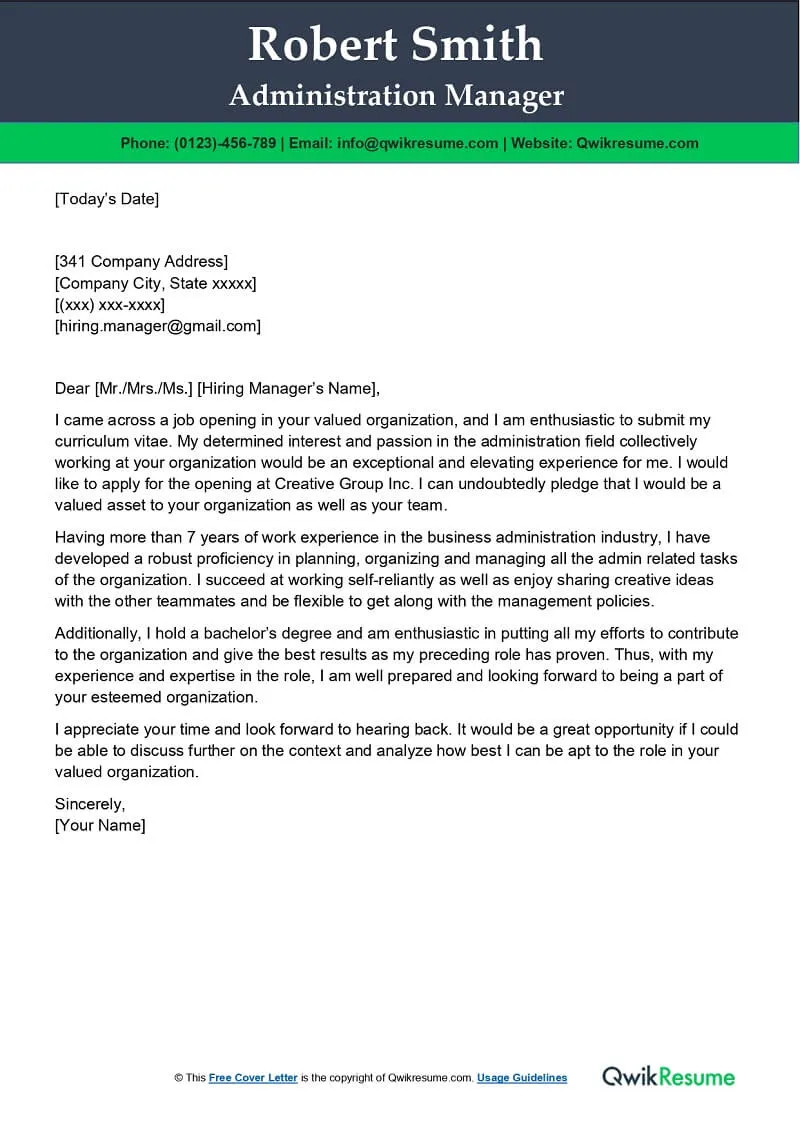
Why an Admin Cover Letter Matters
In the competitive job market, particularly for administration roles, a well-crafted cover letter is your first impression. It’s a crucial tool that can significantly increase your chances of landing an interview. Unlike a resume, which provides a static overview of your skills and experience, a cover letter allows you to showcase your personality, express your enthusiasm for the specific role, and demonstrate how your qualifications align with the company’s needs. It’s your opportunity to tell a story that the resume alone cannot convey. A strong cover letter sets the stage, highlighting your key strengths and making you stand out from other candidates. Consider it your personal sales pitch, designed to convince the hiring manager that you are the perfect fit for the administration job.
Key Components of a Winning Admin Cover Letter
To create a winning cover letter, you must include several key components. Each element contributes to a compelling narrative that demonstrates your suitability for the role. From the correct formatting of your contact information to a persuasive closing, every detail matters. Attention to detail is a critical skill in administration, and your cover letter is an opportunity to showcase this. Ensure you tailor your cover letter to each job application, emphasizing the skills and experiences that align with the specific requirements outlined in the job description. A generic cover letter can be easily dismissed, but a personalized one shows you’ve done your research and are genuinely interested in the position. Remember, your goal is not just to list your qualifications but to convince the hiring manager that you are the best candidate.
Your Contact Information

Begin your cover letter with your contact information. This should include your full name, phone number, email address, and optionally, your LinkedIn profile URL. Ensure your email address is professional-sounding (e.g., john.doe@email.com) rather than informal. Place this information at the top of your letter, either left-aligned or centered. Accuracy is key; double-check all details to ensure the hiring manager can easily reach you. Providing a professional and easy-to-read contact section sets a positive tone from the start, demonstrating your attention to detail, a critical skill for administrative professionals. (Image filename admin-cover-letter-intro.webp)
The Hiring Manager’s Details
Next, include the hiring manager’s name, title, and the company’s address. If possible, address the letter to a specific person, as this personal touch shows you’ve done your research and are genuinely interested in the role. If you are unable to find the hiring manager’s name, use a formal salutation like ‘Dear Hiring Manager’ instead of a generic greeting. This demonstrates your initiative and professionalism. (Image filename hiring-manager-details.webp)
A Strong Opening
Your opening paragraph is your hook. It should immediately grab the hiring manager’s attention and make them want to read more. Start by stating the position you’re applying for and where you found the job listing. Then, briefly mention why you’re interested in the role and the company. Consider including a strong statement about why you are a great fit, such as a relevant achievement or a skill that aligns with the job’s requirements. Avoid generic opening lines; personalize your introduction to demonstrate genuine interest and understanding of the company’s needs. (Image filename strong-opening-cover-letter.webp)
Highlighting Your Skills and Experience

The core of your cover letter should focus on highlighting your relevant skills and experiences. This is where you convince the hiring manager that you have what it takes to excel in the administrative role. Don’t just list your skills; provide specific examples of how you’ve used those skills to achieve results in previous roles. Use action verbs to describe your accomplishments, and whenever possible, quantify your achievements with data and metrics. For example, instead of saying you ‘managed projects,’ say you ‘managed multiple projects simultaneously, delivering them on time and within budget.’ Your goal is to provide concrete evidence that backs up your claims and demonstrates your capabilities.
Quantify Your Accomplishments
Whenever possible, quantify your achievements. Numbers and data make your accomplishments more impactful and demonstrate your ability to deliver results. For example, instead of saying you ‘improved office efficiency,’ state that you ‘reduced office supply costs by 15% within six months.’ Other examples include the number of projects you managed, the amount of money you saved, or the percentage increase in productivity. (Image filename quantify-accomplishments.webp)
Tailoring to the Job Description
Carefully review the job description and tailor your cover letter to match the specific requirements. Identify the key skills and experiences the employer is seeking, and highlight those in your letter. Use the same keywords and phrases from the job description, but don’t just copy and paste. Instead, integrate those terms naturally into your sentences. This shows the hiring manager that you understand the role and possess the qualifications they are looking for. Tailoring your letter demonstrates attention to detail and a genuine interest in the position, making you a more compelling candidate. (Image filename tailor-cover-letter.webp)
Showcase Your Soft Skills

While technical skills are important, don’t overlook the importance of soft skills in an administrative role. Highlight your communication, organization, problem-solving, and time-management abilities. Provide examples of how you’ve used these skills in previous roles. For instance, you can describe a situation where you effectively communicated with stakeholders, organized complex projects, or resolved issues in a timely manner. Soft skills are critical for administrative professionals who need to work effectively with various teams and handle multiple tasks simultaneously. (Image filename admin-soft-skills.webp)
Demonstrating Your Enthusiasm
Your cover letter should convey your enthusiasm for the role and the company. Hiring managers want to hire people who are genuinely interested in the opportunity. Show your excitement by explaining why you are drawn to the position and what you admire about the company. This can include discussing the company’s mission, values, or recent achievements that resonate with you. Demonstrating enthusiasm can set you apart from other candidates who may have similar qualifications but lack the passion for the role. Researching the company and mentioning specific aspects that appeal to you will show your genuine interest and make your application more memorable.
Researching the Company
Before writing your cover letter, thoroughly research the company. Understand its mission, values, recent projects, and culture. This information will help you tailor your letter and demonstrate your interest. Mention specific aspects of the company that appeal to you, such as its commitment to innovation, its impact on the community, or its employee-friendly policies. This shows the hiring manager that you’ve taken the time to understand the organization and are genuinely interested in being a part of it. This preparation will also help you answer interview questions more confidently. (Image filename company-research.webp)
Expressing Your Fit

Clearly explain why you are a good fit for the role and the company. Connect your skills, experience, and personality to the job requirements and the company’s values. Explain how you can contribute to the team and help the company achieve its goals. This includes highlighting your relevant skills and experiences and explaining how they align with the company’s needs. Emphasize how your skills and experiences align with the job description and the company’s values. (Image filename express-fit.webp)
A Powerful Closing
Your closing paragraph should summarize your key qualifications and reiterate your interest in the role. Thank the hiring manager for their time and consideration. Always include a call to action, encouraging them to contact you for an interview. End on a positive and confident note, leaving a lasting impression. Avoid generic closings; instead, personalize your final statement to reinforce your enthusiasm and suitability for the position. (Image filename powerful-closing.webp)
Call to Action
End your cover letter with a clear call to action. Encourage the hiring manager to contact you for an interview or to discuss your qualifications further. Provide your contact information again, making it easy for them to reach you. A strong call to action demonstrates your initiative and confidence in your abilities. Thank the hiring manager for their time and consideration. (Image filename call-to-action.webp)
Proofreading and Formatting

Before submitting your cover letter, proofread it carefully for any errors in grammar, spelling, and punctuation. Errors can create a negative impression and undermine your credibility. Use a professional and easy-to-read format. Ensure the layout is clean and organized, making it easy for the hiring manager to read and understand your letter. A well-formatted and error-free cover letter demonstrates your attention to detail and professionalism. Consider using a professional template to ensure a polished look.
Formatting for Readability
Use a clear and professional font, such as Times New Roman, Arial, or Calibri. Maintain consistent font sizes throughout the letter, typically 11 or 12 points. Use single-spaced lines with a space between paragraphs to make the text easy to read. Avoid using excessive formatting, such as bolding or underlining, unless it’s essential. Ensure your cover letter is well-organized with clear headings and concise paragraphs. A well-formatted letter is easier to read and shows your attention to detail. (Image filename proofreading-cover-letter.webp)
Proofreading for Errors
Carefully proofread your cover letter for any errors in grammar, spelling, and punctuation. Read your letter aloud to catch any awkward phrasing or sentences that don’t make sense. Consider having a friend or family member proofread your letter as well, as they may catch errors you’ve missed. Ensure your letter is free of typos and grammatical errors, as they can undermine your credibility. (Image filename proofreading-cover-letter.webp)
Admin Cover Letter Examples

Reviewing admin cover letter examples can give you valuable insights into formatting, tone, and content. Look for examples that align with your experience level and the type of job you are applying for. Analyze how the examples highlight skills, quantify achievements, and express enthusiasm. Tailor these examples to your specific situation, ensuring your cover letter is unique and reflects your personality and qualifications. Using these examples as a guide can significantly improve your cover letter, leading to more interviews and job offers. Don’t copy examples directly; instead, use them as inspiration to craft a cover letter that is authentic to you. (Image filename winning-admin-cover-letter.webp)