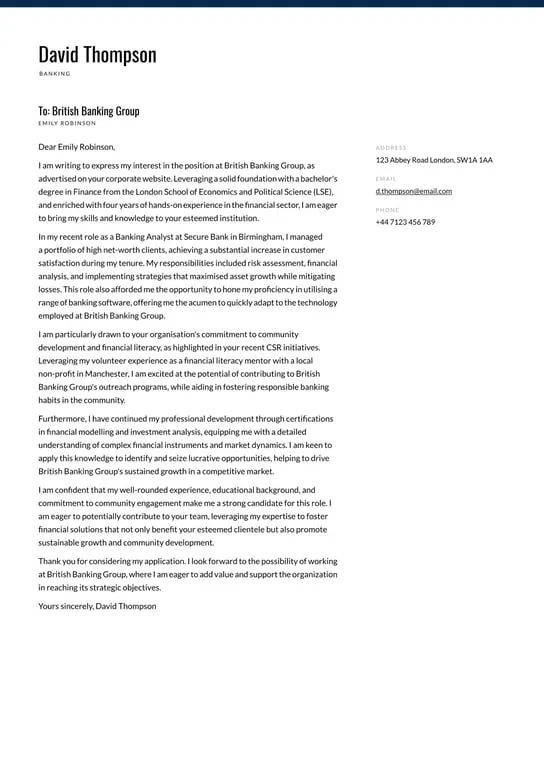
Why a Great Banking Cover Letter Matters
In the competitive world of banking, a well-crafted cover letter can be your golden ticket to landing an interview. It’s more than just a formality; it’s your opportunity to make a strong first impression and set yourself apart from other applicants. A compelling cover letter showcases your personality, enthusiasm, and qualifications in a way that a resume alone cannot. It allows you to tell your story, highlighting your unique skills and experiences in the context of the specific banking position you are targeting. It is your chance to present yourself as more than just a list of qualifications but as a potential asset to the bank, someone who understands the industry and is genuinely interested in the role. A generic cover letter will likely end up in the recycle bin, but a tailored, thoughtful letter can significantly increase your chances of getting noticed and ultimately, securing a job offer. This document will act as your ambassador to the hiring manager and set the tone for your entire application process.
Highlighting Your Skills
Your cover letter is the ideal space to showcase your skills and how they align with the requirements of the banking position. Go beyond simply listing your abilities; demonstrate them through specific examples. For instance, if the job description emphasizes customer service, describe a situation where you successfully resolved a complex customer issue, highlighting your communication, problem-solving, and empathy skills. If the role requires analytical skills, share an instance where you used data to improve efficiency or increase revenue. The key is to select the most relevant skills for the specific job and provide concrete evidence of your proficiency. This will not only demonstrate your capabilities but also show the hiring manager that you understand the demands of the role. Use action verbs to describe your accomplishments. Instead of saying ‘Responsible for customer inquiries’, try ‘Managed customer inquiries, resolving issues efficiently and maintaining a high satisfaction rate’. Tailoring the skills to match those listed in the job description will also increase your chances of getting through applicant tracking systems (ATS).
Quantifying Achievements

Don’t just tell the hiring manager what you did; show them the impact of your work. Quantify your achievements whenever possible. Instead of stating ‘Improved customer satisfaction,’ provide concrete numbers such as ‘Increased customer satisfaction scores by 15% through implementing a new feedback system.’ Similarly, if you increased sales, mention the percentage or dollar amount of the increase. When describing cost savings, state the exact amount or percentage. Numbers add credibility and make your accomplishments more tangible and impressive. Use metrics that directly relate to the role and the bank’s goals. This demonstrates that you understand the importance of measurable results and that you are a proactive, results-oriented individual. Quantifying your achievements proves you can add value to the bank. Remember that it’s not about inflating your resume, but providing a clear picture of what you have contributed in previous positions, which will likely carry forward to the new position.
Tailoring to the Specific Bank
A generic cover letter is a red flag for recruiters. Tailor each cover letter to the specific bank and the particular role you are applying for. Start by researching the bank: understand its mission, values, recent news, and any specific initiatives it’s currently focused on. Mentioning these details in your cover letter shows that you have taken the time to learn about the bank and are genuinely interested in joining their team. Refer to the job description and highlight the skills and experiences that align with the requirements. Use the same keywords and phrases from the job posting to demonstrate that you meet the qualifications. Explain why you are a good fit for this specific bank and why their values resonate with you. By tailoring your cover letter, you show the hiring manager that you are not just sending out mass applications but that you are genuinely interested in working for their institution and understand their specific needs. It will make you stand out from other applicants who may have a more general approach to their applications.
Key Components of a Strong Banking Cover Letter
Contact Information and Salutation

Begin your cover letter with your contact information at the top, including your name, phone number, email address, and LinkedIn profile URL (optional). This makes it easy for the hiring manager to contact you. Address the letter to a specific person whenever possible. Research the hiring manager’s name on the bank’s website or LinkedIn. A personalized salutation, such as ‘Dear Mr./Ms. [Last Name],’ shows that you’ve done your research and that you’re taking the application seriously. If you can’t find a specific name, use a professional greeting like ‘Dear Hiring Manager.’ Avoid generic greetings such as ‘To Whom It May Concern,’ as they indicate a lack of effort and personalization.
The Opening Paragraph Grab Attention
Your opening paragraph is your chance to capture the hiring manager’s attention and make them want to read more. Start with a strong hook, such as an enthusiastic statement about your interest in the role or the bank. Briefly mention how you learned about the position and immediately state the position you are applying for. You should also mention one or two key skills or achievements that make you a strong candidate. Keep the opening concise and impactful, setting the stage for the rest of your letter. The goal is to grab the reader’s attention and demonstrate your enthusiasm and understanding of the role. An excellent opening can set the tone for the entire application and significantly increase your chances of getting noticed and moving forward in the hiring process. The opening should make the reader want to continue reading.
Body Paragraphs Showcasing Skills and Experience
The body paragraphs are where you showcase your skills, experience, and achievements in detail. Structure your paragraphs logically, focusing on the most relevant information for the specific banking role. Start with a brief summary of your relevant experience and then elaborate on specific achievements and skills. Use the STAR method (Situation, Task, Action, Result) to structure your examples, providing context, describing the challenge or task, outlining the actions you took, and quantifying the results of your efforts. This method helps demonstrate your capabilities in a clear, concise, and compelling manner. Highlight how your skills align with the job description, and use industry-specific keywords to show your understanding of banking terminology and practices. Ensure your paragraphs are well-organized and easy to read, with clear transitions between ideas, so the hiring manager can quickly grasp your qualifications and value.
Highlight Relevant Banking Experience

When discussing your banking experience, focus on roles and responsibilities directly relevant to the position. Describe your past roles and the contributions you made. Use specific examples to illustrate your skills, such as managing a portfolio of clients, processing financial transactions, or analyzing financial statements. If you have experience in a related area like customer service or sales, highlight how your skills are transferable and how they can contribute to success in the banking role. Show the hiring manager that you understand the specific needs of the position and can apply your experience effectively. Tailor your language to match the banking industry and highlight any certifications or specialized training that relate to the role. Provide clear evidence of your successes, demonstrating the positive impact you have had in your previous roles. This approach provides a clear link between your past experience and the bank’s requirements.
Showcase Transferable Skills
Even if you don’t have direct banking experience, highlight transferable skills that are valuable in the banking industry. These might include customer service, communication, analytical skills, problem-solving, and attention to detail. Provide examples of how you have used these skills in previous roles or situations. If you have strong communication skills, provide an example of how you successfully explained complex financial concepts to customers. If you possess analytical skills, describe how you used data to make a decision that positively impacted your previous employer. Demonstrate how these transferable skills are applicable to the banking position you are applying for. The ability to show how your skills can translate to the new role can set you apart and prove your potential to thrive in the banking sector. Tailor your transferable skills to align with the job description and emphasize their relevance to the specific role.
The Closing Paragraph Call to Action
End your cover letter with a strong call to action. Reiterate your interest in the position and the bank, and express your enthusiasm for the opportunity to contribute to their team. State that you are available for an interview and provide your contact information one last time. Thank the hiring manager for their time and consideration. Be confident and professional in your closing, making it clear that you are eager to discuss your qualifications further. Avoid generic phrases and make it clear that you are proactive and ready to take the next steps in the hiring process. You want the reader to feel compelled to contact you. A well-crafted closing can significantly increase your chances of getting an interview.
Formatting and Proofreading

Font and Layout Guidelines
Use a professional and easy-to-read font, such as Times New Roman, Arial, or Calibri. Keep the font size between 10 and 12 points. Use a standard business letter format, with a clear heading, proper spacing, and consistent margins. Ensure your cover letter is well-organized and easy to read. Use bullet points to highlight key skills and achievements. Keep your letter concise and to the point, ideally within one page. A clean and professional format makes a positive impression and demonstrates your attention to detail. Using proper formatting shows respect for the recipient and makes it easier for them to quickly grasp your qualifications. Aim for visual appeal to attract attention and maintain the reader’s interest.
Proofreading for Errors
Proofread your cover letter meticulously for any grammatical errors, typos, or inconsistencies. Errors can undermine your credibility and give the impression that you lack attention to detail. Read your letter aloud to catch any awkward phrasing or sentence structure issues. Ask a friend, family member, or career advisor to review your letter as well. A second pair of eyes can often catch mistakes that you might miss. Ensure that all the information is accurate, including the bank’s name, the hiring manager’s name, and the job title. A polished and error-free cover letter demonstrates professionalism and significantly increases your chances of making a positive impression.