Highlighting Your Biomedical Engineering Skills
In the competitive field of biomedical engineering, a compelling cover letter is your key to unlocking dream opportunities. This document isn’t merely a formality; it’s a chance to showcase your unique skills and experiences in a way that a resume alone cannot. To effectively highlight your biomedical engineering skills, focus on the technical proficiencies you possess. This includes expertise in areas such as medical imaging, biomaterials, biomechanics, and instrumentation. Consider the specific requirements of the job you’re applying for, and tailor your skills section to match. For instance, if the position emphasizes experience in designing medical devices, make sure to highlight your related design projects and the specific software or tools you’re proficient in using, such as CAD or simulation software. Furthermore, go beyond listing skills; demonstrate how you’ve applied these skills to solve problems or achieve results. Provide specific examples of projects where you utilized your skills to improve patient outcomes, develop innovative solutions, or contribute to research advancements. Quantify your contributions whenever possible, providing concrete data that shows the impact of your work. This makes your claims more credible and highlights the value you can bring to the employer.
Quantify Your Achievements in Your Cover Letter
One of the most effective ways to make your cover letter stand out is to quantify your achievements. Instead of simply stating you have experience, provide concrete data and metrics that demonstrate the impact of your work. This allows the hiring manager to quickly understand the value you bring to the table. For example, if you improved the efficiency of a medical device design, specify by what percentage. If you contributed to a research project, mention the number of publications or the grant funding secured. Did you reduce costs, improve patient outcomes, or expedite project timelines? Include these details to showcase your impact. When describing your achievements, use action verbs and focus on results. Rather than saying “Assisted in research,” try “Led the analysis of 50 patient samples, resulting in a 15% improvement in diagnostic accuracy.” Use numbers and percentages to make your accomplishments more tangible and memorable. This approach gives a clear picture of your capabilities and allows employers to see the tangible benefits of hiring you. Remember, the goal is to paint a vivid picture of your contributions and show how you can contribute to the success of the organization.
Showcase Relevant Biomedical Engineering Experience

Your cover letter should spotlight your biomedical engineering experience in a way that is both concise and compelling. Begin by reviewing the job description to identify the key skills and experiences the employer is seeking. Then, tailor your letter to align with these requirements, highlighting the aspects of your background that are most relevant. Whether you’re an experienced professional or a recent graduate, focus on projects, internships, and research experiences that demonstrate your abilities. For instance, if the job requires experience in medical imaging, detail any projects where you designed, developed, or analyzed imaging systems. Mention the technologies you worked with, the challenges you overcame, and the outcomes of your work. Include specific details about the responsibilities you held, the tools and techniques you utilized, and the results you achieved. If you’ve completed research projects, summarize your contributions, the methodologies used, and any publications or presentations that resulted from your work. For internships, describe the tasks you undertook, the skills you developed, and the impact of your work on the organization. Make sure to use keywords from the job description to help your application pass through applicant tracking systems (ATS) and catch the eye of the hiring manager.
Tailoring Your Cover Letter to the Job
One of the most critical steps in writing a successful cover letter is tailoring it to each job application. A generic letter will likely get lost in the pile, while a customized letter demonstrates your genuine interest and suitability for the specific role. Start by thoroughly reading the job description and identifying the key requirements, skills, and responsibilities. Then, use this information to adjust your cover letter, highlighting the experiences and skills that directly align with the job requirements. Customize your letter to reflect the specific needs of the employer. For instance, if the job description mentions a need for expertise in a particular area of biomedical engineering, such as tissue engineering or biomechanics, make sure to emphasize your relevant experience and knowledge. If the job emphasizes teamwork or leadership, provide examples of your collaborative projects or leadership roles. The more you can demonstrate that you understand the needs of the employer and that you possess the skills and experience they’re looking for, the better your chances of getting noticed. Customization also involves addressing the company’s mission, values, and culture. Show that you’ve researched the company and understand its goals, and explain how your skills and aspirations align with theirs. This shows you’re not just looking for any job, but that you’re specifically interested in this opportunity and this company. Tailoring your cover letter takes extra effort, but it significantly increases your chances of landing an interview.
Key Sections of a Biomedical Engineering Cover Letter
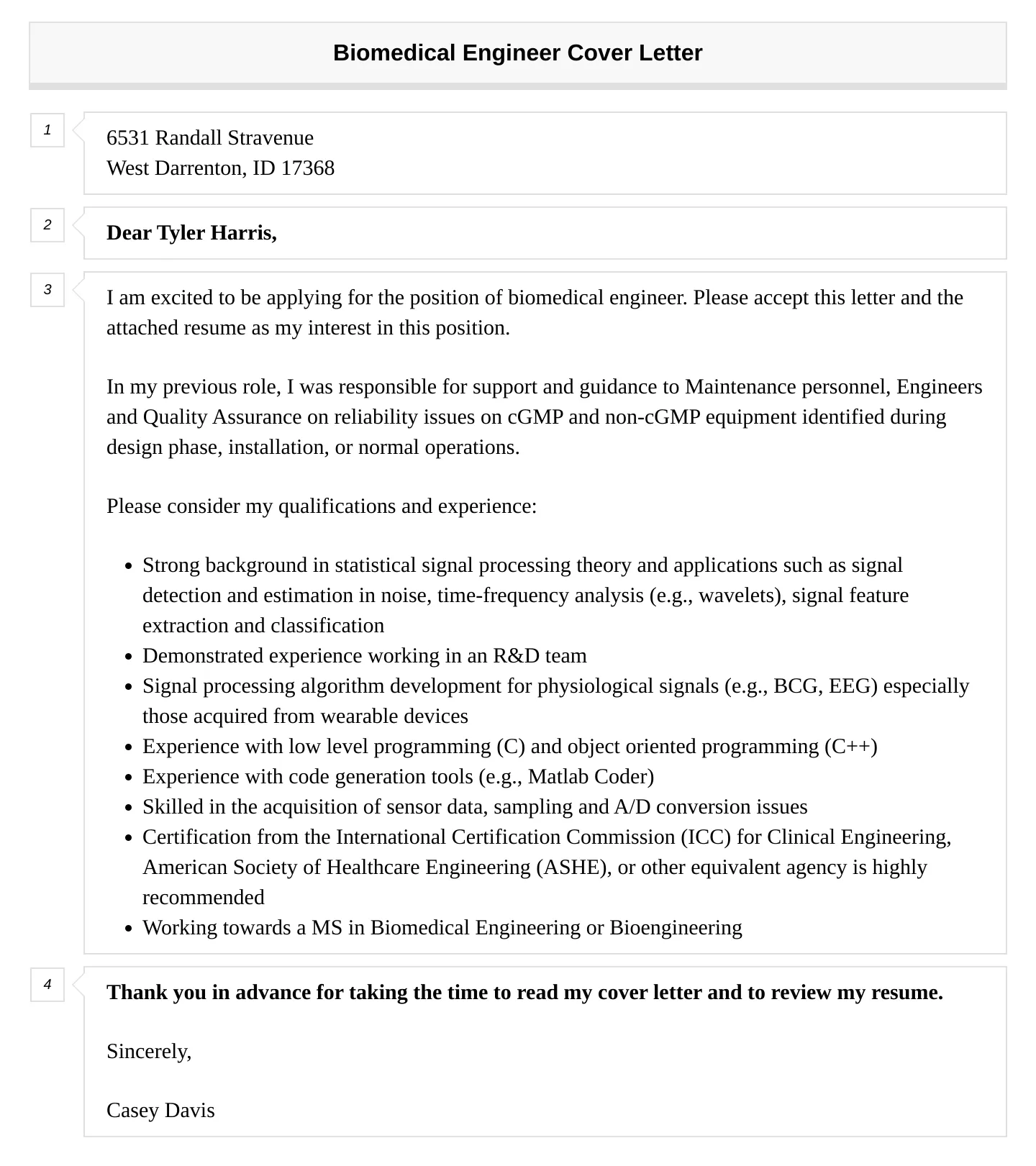
A well-structured cover letter for a biomedical engineering position should include several key sections, each serving a specific purpose in presenting your qualifications and interest in the role. The sections typically include contact information, a professional salutation, an opening paragraph, a body paragraph (or several), and a closing paragraph. At the top, include your contact information: your name, address, phone number, and email. This makes it easy for the hiring manager to reach you. Use a professional salutation like “Dear [Hiring Manager Name]” or, if the name is unavailable, “Dear [Hiring Team]”. This sets a formal tone. The opening paragraph should immediately grab the reader’s attention. Briefly state the position you’re applying for and how you found the opportunity. Mention something that excites you about the role or the company, demonstrating your enthusiasm. The body paragraphs are the meat of your letter, where you detail your skills, experience, and achievements. Focus on the most relevant aspects of your background, providing specific examples and quantifying your contributions whenever possible. The closing paragraph should reiterate your interest in the role and thank the hiring manager for their time and consideration. Include a call to action, such as expressing your eagerness for an interview.
Contact Information and Salutation

The contact information and salutation are the first elements of your cover letter, and it is important to get them right as they set the tone for the entire document. Begin by including your full name, address, phone number, and professional email address at the top. Ensure that your email address is professional-sounding, using your name rather than a nickname or informal phrase. This information should be easily accessible and clearly formatted. Following your contact information, the salutation should be formal and personalized. If you know the name of the hiring manager, use it. For example, “Dear Mr./Ms. [Last Name]”. If you’re unsure of the hiring manager’s name, try to find it online. LinkedIn is an excellent resource for this. If you cannot find a name, a general salutation such as “Dear Hiring Manager” or “Dear [Department] Hiring Team” is appropriate. Avoid generic salutations such as “To Whom It May Concern”, as these can make your letter seem impersonal. Your attention to these details will help to show professionalism and attention to detail, both of which are critical in the biomedical engineering field.
Opening Paragraph Strategies
The opening paragraph is your opportunity to make a strong first impression and capture the hiring manager’s attention. Start by clearly stating the position you’re applying for. Then, immediately express your enthusiasm for the role and the company. Show that you understand what the company does and why you’re excited about contributing to their mission. Consider a few different approaches to the opening paragraph. One strategy is to mention a mutual connection, such as a person who referred you. This adds a personal touch and can make your application stand out. Another approach is to briefly highlight a key accomplishment or skill that aligns perfectly with the job requirements. For instance, you might mention a successful project or a specific technology you’ve mastered. Alternatively, you can simply express your excitement about the opportunity and mention something specific that drew your interest to the company or the role. Whatever strategy you choose, keep the opening concise, engaging, and tailored to the specific job and company. A strong opening sets the stage for the rest of your letter and encourages the reader to continue.
Body Paragraph: Skills and Experience
The body paragraphs are where you demonstrate your value to the employer. This section should detail your skills and experience in a way that is compelling and relevant to the job requirements. Start by identifying the key skills and experiences the employer is seeking, often listed in the job description. Then, use your body paragraphs to highlight how your background aligns with these requirements. Provide specific examples that demonstrate your capabilities. For each skill or experience, describe a project, task, or role where you utilized it. Focus on the results you achieved, using quantifiable data whenever possible. For instance, instead of saying “Managed a project,” state “Managed a project that reduced costs by 15% and was completed two weeks ahead of schedule.” Use action verbs to describe your accomplishments, such as “designed”, “developed”, “analyzed”, “implemented”, or “led.” When describing your experience, it’s also useful to mention any tools, technologies, or methodologies you’re proficient in. For example, if the job requires experience in medical imaging, you might mention your proficiency in using specific software or your experience with particular imaging techniques. Tailor your language to the job and company. The more you can demonstrate your ability to fulfill the requirements of the role, the stronger your application will be. Aim for clarity, conciseness, and relevance in your body paragraphs.
Body Paragraph: Project Highlights

In your cover letter, highlight project achievements to showcase your practical skills and the impact of your work. Select projects that directly relate to the job description and the needs of the company. The most effective way to describe a project is to follow the STAR method: Situation, Task, Action, Result. Briefly describe the Situation – the context or the problem you were trying to solve. Then, detail your Task – what you were required to do. Next, explain the Action – the specific steps you took to address the challenge. Lastly, and most importantly, present the Result – what was the outcome of your efforts? Use numbers and metrics to quantify your achievements whenever possible. For example, instead of saying, “Improved the design of a medical device,” try, “Redesigned the device, resulting in a 20% increase in efficiency and a 10% reduction in manufacturing costs.” Mention the tools and technologies you used during the project, as this demonstrates your technical proficiency. If the project involved teamwork, describe your role within the team and how you collaborated with others to achieve a common goal. Make sure each project you highlight demonstrates specific skills and outcomes, creating a compelling narrative of your value.
Closing Paragraph: Call to Action
Your closing paragraph should leave a lasting positive impression and encourage the hiring manager to take the next step. Reiterate your interest in the position and your enthusiasm for the opportunity. Briefly summarize why you are a strong fit for the role, emphasizing the key skills and experiences that make you an ideal candidate. Always include a clear call to action. Express your eagerness for an interview and let the hiring manager know how they can contact you. For example, you might say, “I am very excited about the opportunity to contribute to [Company Name] and would welcome the chance to discuss my qualifications further in an interview. I can be reached at [phone number] or [email address].” Make it easy for them to respond. Thank the hiring manager for their time and consideration. A simple “Thank you for your time and consideration” is sufficient. It’s essential to proofread your closing paragraph carefully to ensure it is free of errors and conveys a professional tone. The closing paragraph is your final opportunity to make a positive impact, so make it count.
Proofreading and Formatting
Proofreading and formatting are critical steps that ensure your cover letter is polished and professional. Start by thoroughly proofreading your letter for any grammatical errors, spelling mistakes, and typos. Read it multiple times, and consider having a friend or mentor review it as well. Small errors can undermine your credibility, so careful proofreading is essential. Pay attention to the tone of your writing. Ensure it is professional, enthusiastic, and tailored to the specific job and company. The formatting of your cover letter is equally important. Use a clear, easy-to-read font like Arial, Times New Roman, or Calibri, and use a font size of 10 to 12 points. Keep your paragraphs concise and well-structured, with clear topic sentences. Use bullet points to highlight key skills or achievements, making the information easier to scan. Ensure that your margins are consistent and that the spacing between paragraphs is visually appealing. Avoid using excessive bolding or underlining. A clean, well-formatted cover letter is more likely to be read and appreciated by the hiring manager.
Formatting for Readability

Formatting plays a vital role in ensuring your cover letter is easy to read and visually appealing. This is especially important as hiring managers often scan applications quickly. Choose a professional font such as Arial, Times New Roman, or Calibri, and use a font size between 10 and 12 points for the body of your text. This will make your letter comfortable to read without appearing cluttered. Use standard 1-inch margins on all sides of the document. This creates visual space and makes the text easier to process. Break up your text into short, concise paragraphs. Large blocks of text can be overwhelming. Use clear and descriptive headings and subheadings to organize your content, making it easy for the reader to navigate the key points. Use bullet points to highlight key skills, accomplishments, or responsibilities. This makes the information more scannable and helps your most important points stand out. Ensure consistent spacing between lines and paragraphs. Double-space between paragraphs to give the reader’s eye a visual break. Avoid excessive use of bolding, underlining, or italics, as these can distract from the content. The goal is to create a clean, organized, and easy-to-read document that highlights your qualifications effectively. A well-formatted cover letter shows that you pay attention to detail and that you respect the reader’s time.
Common Mistakes to Avoid in Biomedical Engineering Cover Letters
Avoid common mistakes that can significantly hurt your chances of getting an interview. A major error is sending a generic cover letter that isn’t tailored to the specific job or company. Always customize your letter to demonstrate your interest and suitability for the role. Another mistake is simply repeating information from your resume. Instead, use the cover letter to expand on your accomplishments, explain your skills in more detail, and provide context that isn’t included in your resume. Spelling and grammatical errors are also major red flags. Proofread your letter carefully, and consider having someone else review it. Poor formatting can make your letter difficult to read. Make sure the font is readable, the margins are consistent, and the document is well-organized. Including irrelevant information is another mistake. Focus on the experiences and skills that are most relevant to the job requirements. Don’t exaggerate or lie about your qualifications. Honesty and accuracy are essential in your application. Another common issue is a lack of a call to action. Always include a clear statement expressing your interest in the role and inviting the hiring manager to contact you for an interview. Failing to research the company is also a mistake. Show that you’ve done your homework by mentioning their mission, values, or recent projects. Avoiding these common pitfalls can significantly improve the quality and effectiveness of your biomedical engineering cover letter.