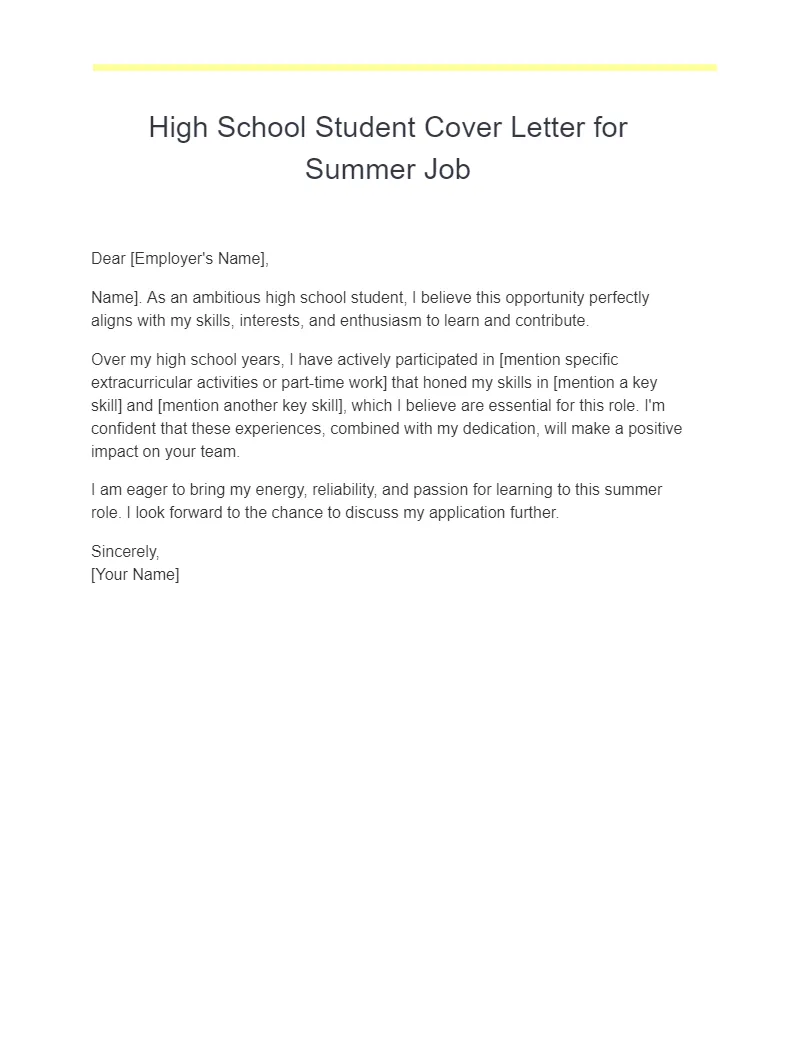
Why a Cover Letter Sample Matters for High School Students
Landing your first job or internship as a high school student can feel daunting. Competition is fierce, and you might feel like you lack the experience to stand out. That’s where a well-crafted cover letter, guided by a strong cover letter sample, becomes your secret weapon. A cover letter allows you to introduce yourself, highlight your skills and enthusiasm, and demonstrate why you’re the perfect fit for the opportunity. Unlike a resume, which provides a snapshot of your experience, a cover letter allows you to tell a story, explaining how your skills align with the employer’s needs and making a compelling case for why they should hire you. Without a solid cover letter, potential employers might overlook your resume, even if you possess the necessary qualifications. A good cover letter sample serves as a template and guide, helping you create a professional and persuasive document that showcases your potential.
Understanding Cover Letter Essentials
Before diving into the specifics of your cover letter, it’s crucial to understand the essential components that make it effective. A cover letter should be concise, professional, and tailored to the specific job or opportunity. It should also demonstrate your understanding of the employer and the role. A well-structured cover letter typically includes an introduction, body paragraphs highlighting your skills and experiences, and a closing paragraph expressing your interest and call to action. When using a cover letter sample, make sure you understand each section’s purpose to properly adapt it to your situation. Remember, the best cover letters tell a story, connecting your background to the employer’s needs and making a memorable impression. Your cover letter should complement your resume, not simply reiterate its contents. This means that your cover letter should expand on your skills and provide context for your experiences. Use a cover letter sample as a springboard to craft a unique, tailored letter that showcases your personality and potential.
Formatting Your Cover Letter

Proper formatting is crucial for making your cover letter easy to read and professional-looking. Choose a clean, readable font like Times New Roman, Arial, or Calibri, and use a font size between 10 and 12 points. Maintain consistent spacing throughout the document, typically single-spacing within paragraphs and double-spacing between paragraphs. Use left alignment and avoid justifying the text, as this can create uneven spacing. Ensure your margins are one inch on all sides. This formatting creates a visually appealing document and ensures it is easy to read. By adhering to these basic formatting guidelines, you’ll instantly make your cover letter appear more professional and polished. Use a cover letter sample to guide you, paying attention to how it structures each section to guide your design.
Contact Information
Start your cover letter with your contact information, including your full name, phone number, and email address. This information should be at the top left of the document. Make sure your email address is professional; avoid using nicknames or informal language. The inclusion of your contact information makes it easy for the employer to reach out to you. Always double-check the information for accuracy before sending your cover letter. Using a cover letter sample can help you ensure that your contact details are properly formatted and placed.
Date
Below your contact information, include the date you are submitting the cover letter. This should be formatted correctly (e.g., Month Day, Year). The date shows that your application is current. This seemingly small detail contributes to the overall professionalism of your document, and a cover letter sample will demonstrate the proper date format.
Employer’s Information

Next, include the employer’s information, including the hiring manager’s name (if known), their title, the company name, and the company’s address. If you are unsure of the hiring manager’s name, use a general salutation like “Dear Hiring Manager.” Researching the employer before you submit your application is a great way to make your cover letter relevant. Including their information demonstrates your attention to detail and your genuine interest in the position. Review a cover letter sample to see how this is structured and formatted.
Salutation
Start your cover letter with a professional salutation. If you know the hiring manager’s name, use “Dear Mr./Ms./Mx. [Last Name].” If you don’t know the hiring manager’s name, you can use “Dear Hiring Manager” or “Dear [Company Name] Hiring Team.” Avoid overly casual salutations like “Hi” or “Hello.” The salutation sets the tone for your cover letter, and a formal approach is usually best, especially for high school students. A cover letter sample will provide examples to guide you.
The Core of Your Cover Letter Sample
The core of your cover letter is where you make your case for why you are the right candidate. This is where you showcase your skills, experience, and enthusiasm. The body of your cover letter typically consists of a few paragraphs, each focused on a specific aspect of your qualifications. The opening paragraph grabs the reader’s attention, the middle paragraphs highlight relevant skills and experience, and the closing paragraph reiterates your interest and calls for action. By following a clear structure, you can ensure your cover letter is easy to read and effectively communicates your qualifications. Using a cover letter sample as a guide can help you structure your thoughts and ensure you include all the necessary information.
The Opening Paragraph

Your opening paragraph should immediately grab the reader’s attention and state the purpose of your letter. Mention the specific job or opportunity you’re applying for and where you saw the listing. You might also briefly mention why you are interested in the position or the company. The goal is to create a positive first impression. Your opening paragraph should set the tone for the rest of your letter, making it clear that you are a serious and enthusiastic candidate. Review a cover letter sample to understand how to craft a compelling opening. Keep it brief, typically 3-4 sentences, and ensure it showcases your personality and enthusiasm for the role.
Highlighting Your Skills and Experience
The body paragraphs are where you provide details about your skills and experience. This is your opportunity to demonstrate why you are qualified for the position. When highlighting your skills and experience, provide specific examples of how you have demonstrated them. Avoid simply listing your skills. Instead, use the STAR method (Situation, Task, Action, Result) to describe your experiences. This helps the reader understand the context of your achievements and the impact you had. Use action verbs to start your sentences and make your accomplishments more compelling. Always tailor this section to the specific requirements of the job, and don’t be afraid to explain any relevant extracurricular activities, volunteer work, or coursework that demonstrates the necessary skills. Review cover letter sample examples to get ideas for describing your skills and experiences.
Skills to Showcase
Identify the key skills the employer is looking for in the job description and highlight those in your cover letter. These might include soft skills like communication, teamwork, and problem-solving, or hard skills, such as specific software or technical abilities. When describing your skills, provide concrete examples. Instead of saying you have strong communication skills, describe a situation where you effectively communicated with others. This could involve public speaking, writing, customer service, or teamwork. Using a cover letter sample, identify common skills to showcase, and use them to create a customized response that addresses the needs of the role and highlights your relevant abilities.
Experience to Mention

Even if you lack extensive work experience, you can still highlight relevant experiences. These could include part-time jobs, volunteer work, extracurricular activities, or school projects. When describing your experience, focus on the skills you developed and the responsibilities you held. If you were a team leader, describe how you managed your team, resolved conflicts, and achieved goals. If you volunteered, explain your responsibilities and the impact you had. Think about how your experiences have prepared you for the role. A cover letter sample will show you different examples of experience that can be used to help you build your case for why you’re the right fit.
Quantifying Your Accomplishments
Whenever possible, quantify your accomplishments. Use numbers and data to demonstrate the impact of your contributions. Instead of saying you improved customer service, state that you reduced customer complaints by a certain percentage. Quantifying your accomplishments makes your cover letter more compelling and shows the employer the value you can bring to the role. Numbers bring your accomplishments to life. They provide tangible evidence of your skills and your ability to achieve results. Review a cover letter sample to get ideas on quantifying your accomplishments.
The Closing Paragraph
Your closing paragraph should reiterate your interest in the position and express your enthusiasm for the opportunity. Thank the employer for their time and consideration. The closing paragraph is your final chance to leave a positive impression, so make it count. Briefly mention how you see yourself contributing to the company’s goals. A strong closing paragraph reinforces your interest and strengthens the chances of the employer inviting you for an interview. A cover letter sample will showcase the different ways to close, so your can determine the best approach for your situation.
Expressing Enthusiasm

Express your enthusiasm for the opportunity. Let the employer know why you are excited about the position and the company. Mention something specific that appeals to you about the role or the organization. This shows that you have done your research and are genuinely interested in the opportunity. Passion is contagious, and letting your enthusiasm shine will make you stand out. In a cover letter sample, focus on how the closing expresses enthusiasm.
Call to Action
End with a clear call to action. Let the employer know you are available for an interview and how they can contact you. Include your phone number and email address. If you are applying online, you can also mention your online portfolio or website. The call to action encourages the employer to take the next step. A well-executed call to action increases the likelihood of the employer contacting you. A cover letter sample will demonstrate the best ways to do this.
Proofreading and Polishing Your Cover Letter
Once you’ve written your cover letter, it’s time to proofread and polish it. This is a crucial step that can make or break your application. Proofreading helps ensure that your cover letter is free of errors and presents you in a professional light. A well-written cover letter demonstrates your attention to detail and your commitment to excellence. It also prevents potential misunderstandings caused by typos or grammatical errors. Take the time to thoroughly review your cover letter before submitting it. Get a second pair of eyes. Ask a teacher, friend, or family member to review your cover letter for any errors. Reviewing your cover letter is a necessary step in crafting a professional and successful application.
Common Mistakes to Avoid in Your Cover Letter

Even with a cover letter sample as a guide, it’s easy to make mistakes. Common mistakes can undermine your application and prevent you from getting an interview. Awareness of common pitfalls can help you create a compelling cover letter. Common errors can be easily fixed by diligent proofreading and revision. A cover letter sample can help you avoid these common errors.
Grammar and Spelling Errors
Typos and grammatical errors can make you look careless and unprofessional. Always proofread your cover letter carefully. Use spell-check and grammar-check tools, but don’t rely on them completely. Read your cover letter out loud to catch any mistakes. A single typo or grammatical error can undermine your credibility. It can also distract the reader and make it difficult for them to focus on your qualifications. This can make the employer less likely to consider your application. When reviewing a cover letter sample, be sure to check for proper grammar and spelling.
Generic Content
Avoid using a generic cover letter that could be sent to any employer. Tailor your cover letter to each specific job you apply for. Research the company and the role, and demonstrate your understanding of the position and the organization’s needs. Demonstrate your passion for the specific job. Generic cover letters don’t show your unique skills and experience. When you adapt a cover letter sample, customize it for the specific job. This customization makes your letter more relevant to the employer. A cover letter that is tailored for a specific role will stand out.
Length and Formatting
Keep your cover letter concise and easy to read. Aim for one page. Avoid using overly long paragraphs or sentences. Ensure your formatting is consistent and professional, as described above. A long and poorly formatted cover letter can be difficult to read. Concise and well-formatted cover letters make a better impression. By sticking to these best practices, you will maximize your chances of getting an interview. A cover letter sample will help you understand formatting and length guidelines.
Cover Letter Sample Tailoring for Specific Applications
When using a cover letter sample, make sure you tailor it to each specific job application. Customize your cover letter to the specific requirements of the job. This shows the employer that you have taken the time to understand their needs and that you are genuinely interested in the position. Tailoring your cover letter will significantly increase your chances of success. Start by reviewing the job description and identifying the key skills and experiences the employer is looking for. Then, highlight those skills and experiences in your cover letter. Be sure to modify the content to reflect your individual experience and aspirations. With each application, the goal is to demonstrate that you’re the perfect candidate for that job.
Modifying Your Sample
Use a cover letter sample as a starting point, but don’t simply copy and paste it. Instead, modify the sample to reflect your individual experiences and qualifications. Replace the generic examples with your own, specific examples. Change the language to match your voice. Personalize your cover letter to make it unique and memorable. A cover letter sample provides a valuable framework but is not meant to be copied exactly. You should always adapt the sample to fit your specific situation. Adapting the content ensures that your cover letter is authentic and shows the employer the real you. Tailoring a cover letter sample boosts your chances of success.
Researching the Employer
Before you submit your cover letter, research the employer and the company. Learn about their mission, values, and culture. Visit their website, read their social media, and find out what they do. Demonstrate your knowledge in your cover letter. Customize your cover letter to reflect your understanding of the company’s needs and goals. Mention specific projects or initiatives that interest you. This level of detail helps you connect with the employer. When you demonstrate your knowledge, you position yourself as a candidate who is truly enthusiastic. This research is essential for creating a compelling and effective cover letter. Refer to a cover letter sample to see how to effectively demonstrate your employer research.