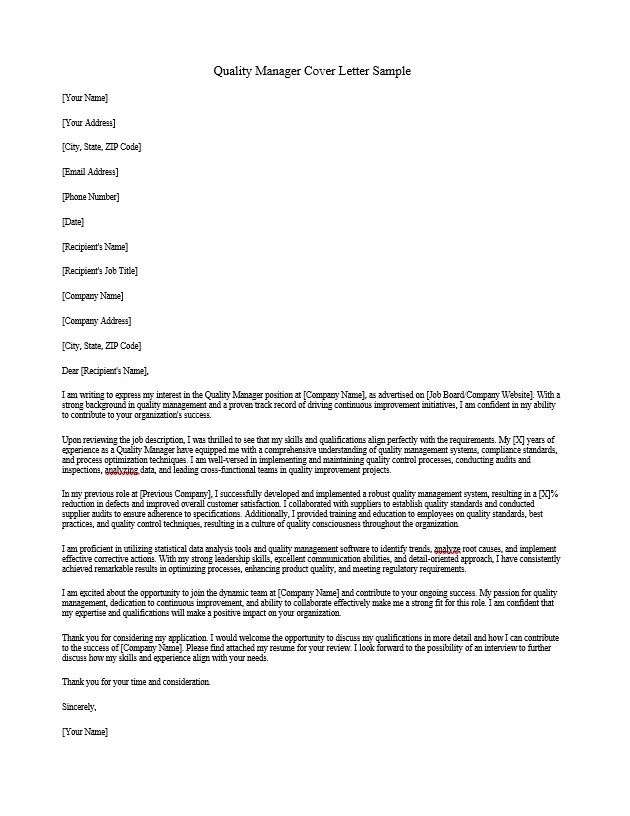
Crafting a Compelling Cover Letter
A cover letter is your first chance to make a positive impression on a potential employer. It’s more than just a formality; it’s an opportunity to showcase your personality, enthusiasm, and qualifications in a way that a resume alone cannot. A compelling cover letter should immediately grab the reader’s attention and make them want to learn more about you. Start with a strong opening that captures their interest, perhaps by mentioning a shared connection or expressing your excitement about the specific role or company. Keep your tone professional yet engaging, avoiding overly formal language that can sound impersonal. Remember that your cover letter should complement your resume, not simply repeat it. Use it to highlight your key skills and experiences in the context of the job requirements, and explain why you’re the perfect fit for the position.
Highlighting Your Quality Management Skills
As a quality manager, your cover letter should prominently feature your quality management skills. This includes your expertise in areas like process improvement, quality control, risk management, and regulatory compliance. Provide specific examples of how you have successfully applied these skills in previous roles. For instance, if you’ve implemented a new quality control system that reduced defects by a certain percentage, be sure to mention it. If you have experience with specific quality standards like ISO 9001 or Six Sigma, mention those as well. Your cover letter is your chance to demonstrate your understanding of quality management principles and your ability to translate those principles into tangible results. Show the hiring manager that you understand their needs, and how your skills will translate into them.
Showcasing Relevant Experience

Tailor your cover letter to the specific requirements of the job description. Review the job posting carefully and identify the key skills and experiences the employer is looking for. Then, highlight the relevant experience from your background that matches those requirements. Don’t simply list your previous job titles and responsibilities; instead, describe your accomplishments and how you contributed to the success of your previous employers. When detailing your experience, use specific examples and quantifiable results whenever possible. Focus on the achievements that demonstrate your ability to excel in the role you are applying for. This targeted approach will show the hiring manager that you have the skills and experience they are looking for.
Quantifying Achievements for Impact
Numbers speak volumes when it comes to demonstrating your impact as a quality manager. Instead of just saying you improved efficiency, state by how much. Instead of saying you reduced errors, specify the percentage decrease. Quantifying your achievements provides concrete evidence of your capabilities and makes your cover letter more compelling. Use metrics such as cost savings, process improvements, defect reduction rates, and customer satisfaction scores to showcase your contributions. For instance, if you led a project that reduced production defects by 15%, be sure to mention it. If you implemented a new training program that improved employee performance by 10%, highlight that as well. Quantifiable achievements demonstrate your value and prove that you can deliver results.
Tailoring Your Letter to the Job
One of the biggest mistakes job seekers make is sending out generic cover letters. Always tailor your cover letter to each job application. This means researching the company and the specific role, and then adjusting your letter to reflect your understanding of their needs and priorities. Demonstrate that you’ve taken the time to learn about the company and its mission. Mention specific aspects of the job description that resonate with your skills and experience. If the job posting emphasizes a particular skill, make sure to highlight your proficiency in that area. Show the hiring manager that you are genuinely interested in the opportunity and that you are a perfect fit for their team. Addressing the specific requirements of the role shows that you are a thoughtful and detail-oriented candidate.
Addressing the Hiring Manager Directly

Whenever possible, address your cover letter to a specific person, rather than using a generic salutation like “To Whom It May Concern.” Research the company’s website or LinkedIn to find the name of the hiring manager or the person responsible for recruiting for the position. Addressing your letter directly demonstrates initiative and attention to detail. It also helps you make a personal connection with the reader, making your letter more engaging and memorable. If you’re unable to find a specific name, try using a professional-sounding title like “Hiring Manager” or “Recruiting Team.” Make sure to double-check the spelling of the person’s name, as a small mistake can make a negative impression.
Using Action Verbs to Showcase Skills
Action verbs make your cover letter more dynamic and engaging. They bring your experiences to life and highlight your accomplishments. Instead of using passive language, such as “responsible for,” use strong action verbs such as “managed,” “implemented,” “led,” “improved,” “developed,” and “achieved.” These verbs show what you did and the impact you made in your previous roles. Start each bullet point or paragraph with a strong action verb to grab the reader’s attention. This will make your cover letter more concise and impactful. Using action verbs makes you sound more confident and demonstrates your proactive approach to your work. Use a variety of action verbs to avoid repetition and make your cover letter more interesting to read.
Formatting Your Cover Letter Professionally
A well-formatted cover letter is easy to read and makes a positive impression. Use a professional font such as Times New Roman, Arial, or Calibri, and keep the font size between 10 and 12 points. Use clear headings and subheadings to break up the text and make it easier to scan. Use bullet points to highlight your key skills and accomplishments. Maintain consistent margins and spacing throughout the letter. Proofread your cover letter carefully to eliminate any typos or grammatical errors. A polished, well-formatted cover letter demonstrates attention to detail, which is crucial for a quality manager. Make sure the layout is clean, uncluttered, and visually appealing. A well-formatted cover letter shows that you care about presenting yourself in the best possible light.
Proofreading and Editing for Perfection

Before submitting your cover letter, proofread it carefully for any errors in grammar, spelling, and punctuation. Errors can undermine your credibility and make you look unprofessional. Read your cover letter aloud to catch any awkward phrasing or typos that you might miss when reading silently. It’s also a good idea to have a friend or colleague review your cover letter. They can provide a fresh perspective and catch any errors you may have missed. Ensure all the information, such as company names, job titles, and dates, are correct. A flawless cover letter shows that you are detail-oriented and committed to quality, which are essential qualities for a quality manager.
By following these seven tips, you can write a cover letter that showcases your skills, experience, and enthusiasm, and greatly increases your chances of landing an interview as a quality manager. Good luck!