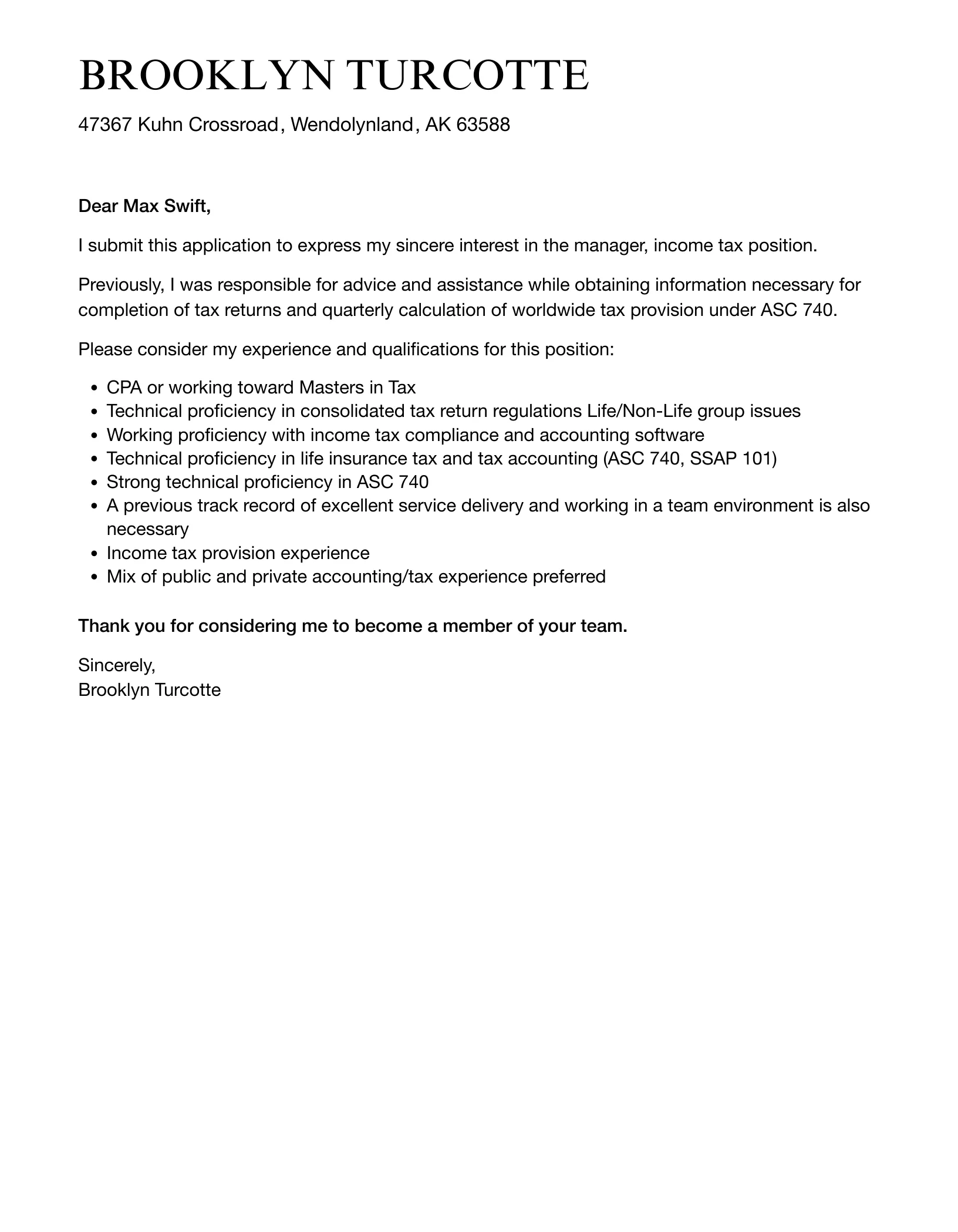
Crafting a Compelling Tax Manager Cover Letter
A well-crafted cover letter is your first opportunity to impress a potential employer and secure an interview for a Tax Manager position. It goes beyond simply restating your resume; it’s where you demonstrate your personality, passion for the role, and understanding of the company. To make a lasting impression, your cover letter must be tailored, concise, and compelling. The goal is to showcase your qualifications, highlighting your relevant experience and skills. A strong cover letter immediately captures the hiring manager’s attention and convinces them that you are worth considering. Focus on the value you bring, explaining how your skills align with the specific needs of the role and the organization. It is your first chance to differentiate yourself from other candidates and present yourself as the best fit for the Tax Manager position. Your cover letter is a critical document in the application process, and it should be treated as such, requiring careful consideration and diligent attention to detail.
Highlighting Your Tax Expertise
Your cover letter should prominently feature your tax expertise. Tax Managers are valued for their in-depth knowledge of tax laws, regulations, and compliance. When detailing your experience, be specific about the areas of tax you specialize in, such as corporate tax, individual tax, international tax, or state and local taxes. Mention your experience with tax planning, tax return preparation, and tax audits. Provide clear examples of how you have successfully managed complex tax situations, minimized tax liabilities, and ensured compliance. Demonstrate your ability to analyze financial data, interpret tax regulations, and provide strategic tax advice. By focusing on your specialized knowledge, you’ll quickly establish credibility with the hiring manager and show why you are the right fit for their team. Showcase a strong foundation in accounting principles, financial reporting, and an understanding of relevant tax software and technologies.
Quantifying Achievements

Quantifying your accomplishments is a key strategy for making your cover letter more impactful. Instead of vaguely stating your responsibilities, use numbers and data to demonstrate your success. For example, rather than saying “Managed a team of tax professionals,” you could write “Managed a team of 10 tax professionals, resulting in a 15% increase in efficiency and a 10% reduction in errors.” Similarly, when describing projects or initiatives, use specific metrics to illustrate your contributions. Consider how you have improved tax compliance rates, reduced tax liabilities, or increased the accuracy of tax filings. By providing concrete examples of your achievements, you show the hiring manager the tangible value you can bring to the role. Using numbers makes your claims more credible and easier to understand, helping you to stand out among other applicants. Remember to highlight achievements relevant to the specific job requirements.
Showcasing Relevant Certifications and Licenses
Include all relevant certifications and licenses in your cover letter to demonstrate your professional qualifications. Common certifications for Tax Managers include Certified Public Accountant (CPA), Certified Management Accountant (CMA), and Enrolled Agent (EA). List these credentials prominently, often near the beginning of the letter, to quickly establish your credibility. If the job description requires specific certifications, make sure to mention them explicitly. Also, mention any continuing professional education (CPE) credits you’ve earned to show your commitment to staying current with tax laws and regulations. These certifications not only validate your expertise but also demonstrate your dedication to the profession. Properly citing your credentials enhances your cover letter’s credibility and can increase your chances of being selected for an interview.
Demonstrating Leadership and Management Skills
A Tax Manager is often expected to lead and manage a team of tax professionals. In your cover letter, it’s important to showcase your leadership and management skills. Describe your experience in team management, including your ability to mentor, train, and motivate team members. Highlight your ability to delegate tasks effectively, manage deadlines, and provide constructive feedback. Detail any successes you’ve had in fostering a positive and productive work environment. Mention any experience you have with performance evaluations, conflict resolution, and employee development. Demonstrate your ability to build and maintain strong working relationships with both team members and other departments within an organization. Consider any leadership roles you’ve held in the past, such as leading projects, initiatives, or committees. Focus on what makes you a great leader.
Examples of Leadership Skills

To effectively demonstrate your leadership skills, provide specific examples of how you’ve led and managed teams. Mention times when you successfully motivated a team to meet or exceed goals. Describe situations where you implemented new processes or technologies to improve efficiency or accuracy. Share instances where you resolved conflicts among team members, resulting in a more cohesive and productive work environment. Highlight instances where you mentored or trained junior staff, helping them advance in their careers. Showcase your ability to make difficult decisions, take ownership of projects, and lead by example. When possible, quantify your accomplishments by highlighting improvements to team performance, such as increased productivity or reduced errors. Specific examples make your leadership claims more convincing and show your potential to effectively manage a team.
Effective Communication and Interpersonal Skills
Tax Managers need excellent communication and interpersonal skills. They must effectively communicate complex tax information to both technical and non-technical audiences. Highlight your ability to write clear, concise reports and correspondence, as well as your ability to present information effectively. Demonstrate your ability to listen actively, understand different perspectives, and build rapport with colleagues, clients, and stakeholders. Provide examples of how you’ve successfully navigated challenging conversations, resolved conflicts, and built strong relationships. Mention your experience in presenting to senior management, working with external auditors, or interacting with clients. The ability to communicate effectively, both verbally and in writing, is a vital skill for a tax manager, and it should be emphasized in your cover letter.
Tailoring Your Cover Letter to the Specific Job
Avoid sending a generic cover letter. Instead, tailor each letter to the specific job and the organization you’re applying to. Review the job description carefully, and highlight the skills and experiences that align with the requirements. Address specific needs mentioned in the job posting, and use keywords from the description throughout your letter. Demonstrate that you understand the company’s mission, values, and industry. Show that you’ve done your research and are genuinely interested in the role. By customizing your cover letter, you demonstrate your attention to detail and your understanding of the specific needs of the company. Tailoring your cover letter increases your chances of getting noticed and demonstrating that you are a great fit for the organization and the role.
Researching the Company and the Role

Before writing your cover letter, thoroughly research the company and the specific role you’re applying for. Visit the company’s website to learn about its mission, values, and culture. Research its products, services, and industry position. Look for information about recent news, achievements, or challenges the company is facing. This information can help you tailor your cover letter to demonstrate your understanding of the company’s needs and how you can contribute to their success. Review the job description carefully, noting the specific requirements, skills, and responsibilities. Identify the key qualifications and tailor your cover letter to highlight your relevant experience. Use the company’s website, LinkedIn, and other online resources to gather information. By demonstrating that you understand the company, you show that you are genuinely interested in the role and are a good fit.
Matching Skills and Experiences
The most critical aspect of a tailored cover letter is matching your skills and experiences with the requirements outlined in the job description. Carefully review the job posting and identify the key skills, experiences, and qualifications the employer is seeking. Then, in your cover letter, explicitly demonstrate how your skills align with these requirements. Provide specific examples from your previous roles that illustrate your ability to fulfill the job’s responsibilities. Use the same language and keywords as the job description whenever possible. Quantify your achievements and provide concrete examples to support your claims. For each skill or experience mentioned in the job description, briefly explain how your background makes you a strong candidate. By explicitly matching your skills and experience, you demonstrate that you are a perfect fit for the role.
Using Keywords from the Job Description
Using relevant keywords from the job description is a crucial strategy for optimizing your cover letter. Applicant Tracking Systems (ATS) often scan cover letters and resumes for specific keywords to determine whether a candidate meets the basic requirements. Carefully analyze the job description, and identify the key skills, experiences, and qualifications the employer is seeking. Integrate these keywords naturally throughout your cover letter. Do not stuff keywords, but instead, use them in context to describe your experience and accomplishments. By using these keywords, you increase the chances that your cover letter will pass through the ATS and be reviewed by a hiring manager. Keywords help to highlight your qualifications, making your cover letter stand out and demonstrating that you are the right fit for the role. This will increase the visibility of your cover letter and enhance your chances of getting an interview.
Formatting and Presentation Tips

The formatting and presentation of your cover letter are critical for making a positive first impression. Use a professional font, such as Times New Roman, Arial, or Calibri, in a readable size (11 or 12 points). Ensure your letter is well-organized and easy to read. Use clear headings, bullet points, and white space to break up large blocks of text. Keep your cover letter concise; aim for one page. Use a professional layout and formatting. Avoid using excessive colors, graphics, or formatting styles. Include a formal salutation (e.g., “Dear Mr./Ms. [Last Name]”) and closing (e.g., “Sincerely,” or “Best regards”). Ensure that your contact information is accurate and prominently displayed. A well-formatted, visually appealing cover letter shows that you pay attention to detail and professionalism, which are essential qualities for a tax manager.
Ensuring Professional Tone and Language
Maintaining a professional tone and using clear, concise language is critical. Write your cover letter in a formal, respectful tone, avoiding slang, jargon, or overly casual language. Use active voice to make your writing more direct and engaging. Proofread your cover letter to eliminate grammatical errors, spelling mistakes, and typos. Your language should reflect the high level of professionalism expected of a tax manager. Focus on your achievements and contributions, using a confident but not arrogant tone. Avoid using clichés or generic phrases. Instead, use specific examples and quantifiable results to showcase your skills and expertise. Your cover letter should reflect your strong written communication skills and attention to detail.
Proofreading and Editing for Perfection
Before submitting your cover letter, proofread and edit it meticulously to ensure perfection. Check for spelling, grammatical errors, punctuation mistakes, and typos. Review the content for clarity, conciseness, and coherence. Ensure that your tone is professional and that your language is clear and precise. Have someone else review your cover letter to provide a fresh perspective and catch any errors you may have missed. This can include a friend, colleague, or career counselor. Ensure all contact information is accurate. Proofreading is a crucial step in the cover letter writing process, as even minor errors can detract from your credibility and professionalism. A polished cover letter demonstrates your attention to detail and your commitment to excellence.