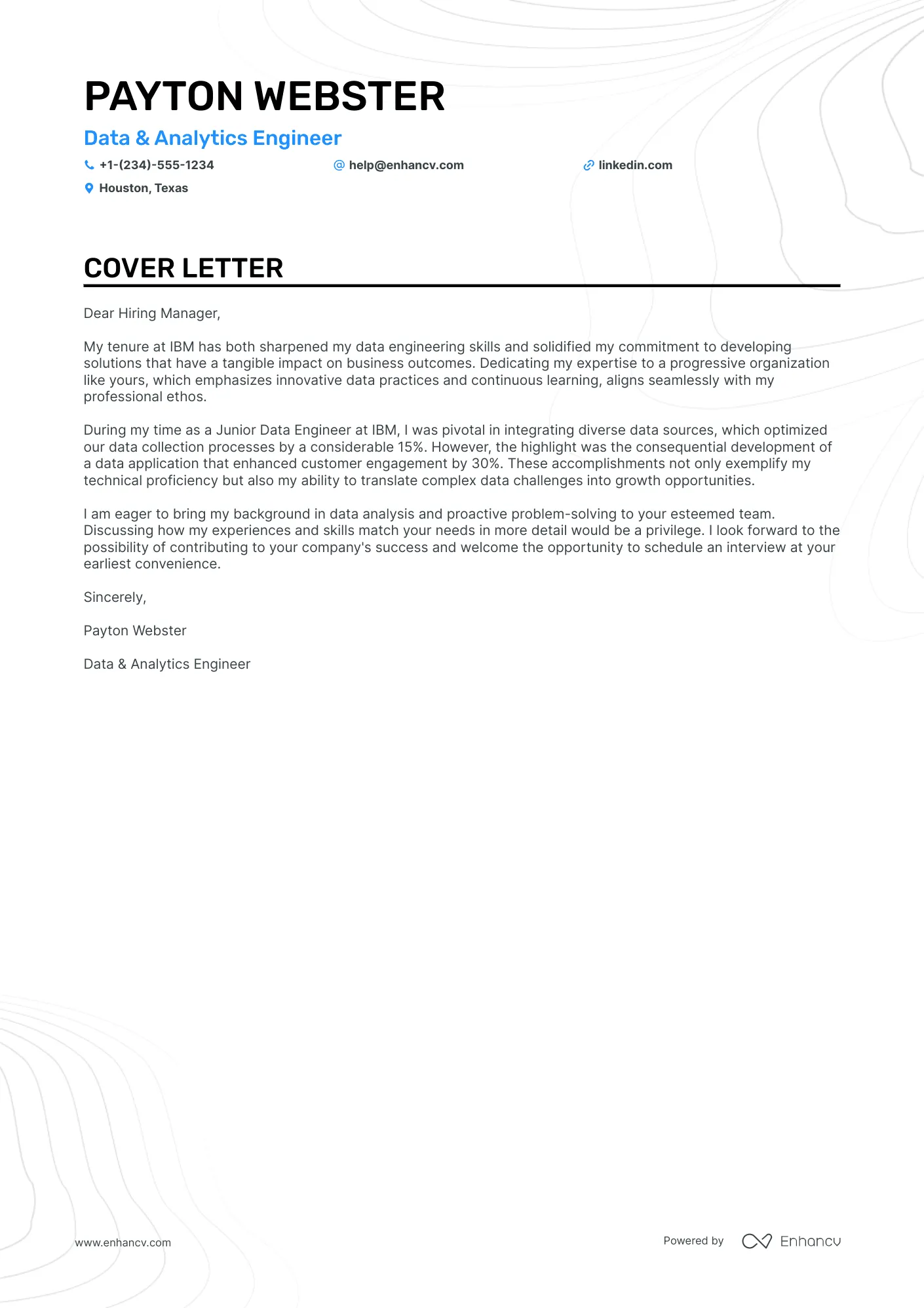
Cover Letter for Data Engineer: Key Elements
A well-crafted cover letter is your first impression on a potential employer. For a Data Engineer, this document provides an opportunity to showcase your technical prowess, project experience, and soft skills, making it a crucial component of your job application. It goes beyond simply listing your qualifications; it’s a chance to narrate your career journey, highlight your accomplishments, and articulate your enthusiasm for the role and the company. Your cover letter should be a concise yet compelling story that grabs the reader’s attention and convinces them that you are the ideal candidate. Remember to tailor each cover letter to the specific job description and company, highlighting the skills and experiences most relevant to the position.
Contact Information and Introduction
Your Name and Contact Details

Begin your cover letter with your full name, address, phone number, and professional email address. Ensure this information is accurate and up-to-date. Using a clean, professional format for this section sets a positive tone from the start. Consider placing this information at the top left or right corner of the letter for easy access. Double-check all details to avoid any errors that could hinder the hiring manager from contacting you. A clear and concise presentation of your contact information reflects your attention to detail and professionalism, which are essential qualities for a Data Engineer.
Personalized Greeting and Introduction
Address the hiring manager or recruiter by name, if possible. Researching the company website or LinkedIn can help you find the correct person. A generic greeting, such as ‘To Whom It May Concern,’ is acceptable but less impactful than a personalized one. In your introduction, state the position you are applying for and briefly mention where you saw the job posting. Keep the introduction brief and to the point, expressing your interest in the role and the company. This sets the stage for the rest of your cover letter, making it clear why you are a suitable candidate. Your enthusiasm should be apparent from the start, showing that you’re genuinely interested in the opportunity.
Highlighting Relevant Skills and Experience
Showcasing Technical Skills

This is where you spotlight your technical expertise. Data Engineers must possess a strong understanding of programming languages (Python, Java, Scala), database technologies (SQL, NoSQL), big data technologies (Hadoop, Spark), and cloud platforms (AWS, Azure, GCP). Clearly state your proficiency in these areas and provide examples of how you have used these skills in previous projects. Use keywords from the job description to tailor your letter and demonstrate that you meet the specific requirements of the role. Avoid simply listing skills; instead, explain how you have applied these skills to solve complex problems or achieve specific outcomes. For example, you might write, ‘Proficient in Python, I developed ETL pipelines using Apache Airflow, resulting in a 30% improvement in data processing efficiency.’
Detailing Project Experience
Provide detailed descriptions of projects where you have applied your skills. For each project, explain your role, the technologies used, the challenges you faced, and the results you achieved. Quantify your contributions whenever possible. For instance, if you designed a data warehouse, specify the size of the data sets, the technologies used (e.g., Snowflake, Redshift), and the benefits of the warehouse (e.g., improved reporting, faster query times). The more specific you are, the better. Use action verbs to describe your accomplishments and focus on demonstrating your ability to deliver tangible results. This section helps the hiring manager understand your practical experience and see how you have tackled real-world data engineering problems.
Quantifying Achievements
Use numbers, percentages, and specific data to quantify your accomplishments. This approach makes your cover letter more compelling and provides concrete evidence of your impact. Instead of saying you ‘improved data processing,’ say, ‘Improved data processing efficiency by 25% by optimizing Spark jobs.’ If you reduced costs, specify the amount saved. If you improved data accuracy, mention the percentage increase. Quantifying your achievements showcases your ability to deliver tangible value and measure your contributions. Use data to make your cover letter more persuasive. For example, “Reduced data latency by 40% by optimizing our data ingestion pipeline, which improved real-time analytics capabilities.”
Demonstrating Soft Skills

Emphasizing Problem-Solving Abilities
Data Engineers must be excellent problem-solvers. Provide examples of how you have overcome challenges in previous projects. Describe the problem, the steps you took to analyze it, the solutions you implemented, and the outcomes you achieved. Highlight your ability to think critically, troubleshoot effectively, and find creative solutions. Mention any specific methodologies you used, such as the Agile or Waterfall frameworks. Your problem-solving abilities are critical in navigating complex data challenges. For instance, ‘Successfully troubleshooted a critical data pipeline failure by identifying and resolving a bottleneck in the data transformation process, ensuring data integrity and timely delivery to stakeholders.’
Expressing Enthusiasm and Company Alignment
Why You’re Interested in the Company

Demonstrate your genuine interest in the company and the role. Research the company’s mission, values, and recent projects. Explain why you are drawn to their work and how your skills and experience align with their goals. Mention specific aspects of the company that resonate with you, such as their culture, their use of innovative technologies, or their impact on the industry. Showing that you have done your homework and that you share their values makes a positive impression. This demonstrates your sincerity and increases the likelihood of your cover letter standing out.
Expressing Your Career Goals
Briefly mention your career aspirations and how this role aligns with your long-term goals. Explain what you hope to achieve in this position and how you can contribute to the company’s success. This shows that you are not just looking for a job but are invested in your career path and the company’s future. Focus on opportunities for growth and professional development within the company. This also shows that you’re looking for a long-term career, not just a temporary position. For instance, ‘I am eager to apply my skills in a dynamic environment and contribute to [Company Name]’s innovative projects, while continuously expanding my knowledge in data engineering.’
Call to Action and Closing
Concluding with Gratitude

Thank the hiring manager for their time and consideration. Express your appreciation for the opportunity to apply for the position. Keep the tone professional and polite. A simple ‘Thank you for your time and consideration’ is sufficient, but you can also mention your excitement about the possibility of joining the team. This shows respect for the hiring process and leaves a positive final impression. This closing statement should be brief, leaving a good final impression.
Requesting an Interview
Clearly state your desire for an interview. This is the final and most important part of your call to action. Express your availability and willingness to discuss your qualifications further. Make it easy for the hiring manager to take the next step. For instance, ‘I am eager to discuss my qualifications in an interview and am available at your earliest convenience.’ Providing your availability shows your enthusiasm and makes it easy for them to schedule a meeting. End with a professional closing, such as ‘Sincerely’ or ‘Best regards,’ followed by your name.