Understanding the Entry Level Nursing Cover Letter
An entry-level nursing cover letter is your first opportunity to make a strong impression on potential employers. It’s a concise, professional document that introduces you, highlights your relevant skills and experiences, and expresses your interest in a specific nursing position. Unlike a resume, which provides a detailed overview of your qualifications, a cover letter allows you to personalize your application and showcase your personality and enthusiasm for the role. Mastering the art of crafting an effective cover letter is essential for standing out from the competition and securing an interview.
Why a Cover Letter is Crucial for Entry Level Nursing
In the competitive field of nursing, a cover letter is not optional; it’s a necessity. For entry-level nurses, it provides a platform to demonstrate your passion for nursing, even if your practical experience is limited. It allows you to explain your career goals and articulate why you’re the ideal candidate for the position. Furthermore, a well-written cover letter can highlight transferable skills acquired from other experiences, such as volunteer work or academic projects. It also gives you the chance to show your communication skills, attention to detail, and understanding of the healthcare facility’s values.
Highlighting Relevant Skills and Experiences

Even with limited professional experience, entry-level nurses possess valuable skills. Your cover letter should emphasize these, making you a more attractive candidate. Consider your clinical rotations, volunteer work, and any relevant coursework. Highlight any experience with patient care, electronic health records (EHR) systems, or specific medical equipment. Quantify your accomplishments whenever possible. For example, if you assisted in a clinical setting, specify the number of patients you helped or any positive outcomes you contributed to. Include any certifications you have, like Basic Life Support (BLS) or Advanced Cardiovascular Life Support (ACLS). The goal is to demonstrate your readiness to embrace the nursing profession and its inherent challenges.
Tailoring Your Cover Letter to the Job
One of the most critical aspects of a successful cover letter is customization. Generic cover letters are easily spotted and often discarded. Each cover letter must be tailored to the specific job you are applying for. Carefully review the job description, identifying the key skills and qualifications the employer is seeking. Then, align your cover letter content with these requirements, providing concrete examples of how your skills match the job’s needs. Use the same keywords and phrases used in the job description to show that you have understood the role’s demands and are a good fit. Showing this kind of job-specific focus makes you stand out.
Researching the Healthcare Facility
Before writing your cover letter, research the healthcare facility. Visit their website, read reviews, and learn about their mission, values, and recent achievements. Demonstrating this knowledge in your cover letter shows your genuine interest in the organization and your understanding of its culture. Mention specific programs or initiatives that resonate with you. If the facility emphasizes patient-centered care, discuss your experience or interest in this area. This extra step can significantly boost your application by showcasing your commitment to working for that specific institution. Showing that you did your homework indicates a proactive approach and desire to join their team.
Formatting Your Entry Level Nursing Cover Letter

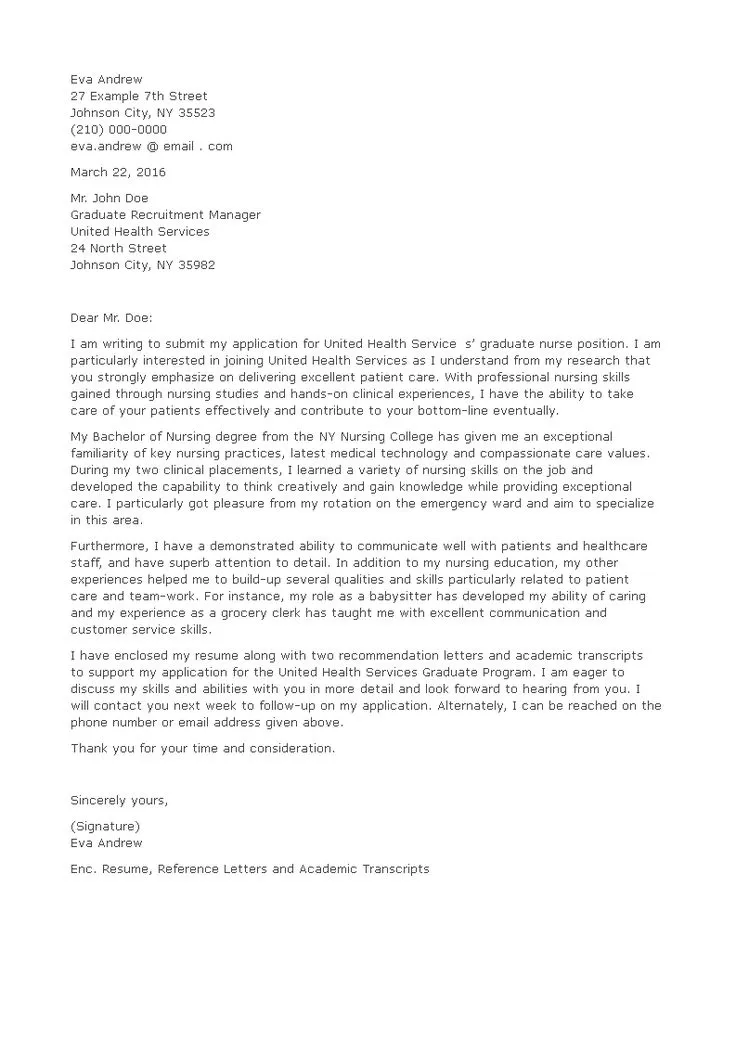
The format of your cover letter is as crucial as its content. Use a professional and easy-to-read format. Start with your contact information, the date, and the employer’s contact information. Choose a standard font, such as Times New Roman or Arial, in a readable size (11-12 points). Use single-spaced lines and a 1-inch margin on all sides. Break your cover letter into clear paragraphs, each addressing a specific point. Keep the letter concise, ideally one page long. Use headings if it helps organize your thoughts. A well-formatted letter looks professional and demonstrates attention to detail.
Contact Information and Salutation
Begin your cover letter with your full name, address, phone number, and email address at the top left of the page. Below this, add the date and the hiring manager’s name, title, and the healthcare facility’s address. Use a professional salutation. If you know the hiring manager’s name, use “Dear Mr./Ms./Mx. [Last Name].” If you don’t, use “Dear Hiring Manager” or “Dear Nursing Department.” Avoid informal greetings. This initial step demonstrates professionalism and respect, setting a positive tone for the rest of your letter. Remember accuracy is key here; double-check all contact details.
Opening Paragraph: Making a Strong First Impression
The opening paragraph is your chance to grab the reader’s attention. State the position you’re applying for and how you learned about the opportunity. Briefly mention your most relevant skill or experience and your enthusiasm for the role. Make a concise statement of your interest in the facility. Avoid generic openings. Instead, aim for a personalized, impactful statement that immediately shows your suitability for the role and your motivation. The goal is to make the reader want to learn more about you.
Body Paragraphs: Showcasing Your Qualifications

Use the body paragraphs to demonstrate your qualifications and how they align with the job requirements. Focus on the key skills mentioned in the job description. Provide specific examples from your clinical rotations, volunteer work, or academic projects. Use the STAR method (Situation, Task, Action, Result) to describe your experiences. Briefly outline the situation, the task you faced, the actions you took, and the positive results. Quantify your achievements whenever possible. For example, “Assisted in the care of 20+ patients per shift, contributing to a 10% reduction in patient falls.” This approach provides concrete evidence of your skills and abilities.
Mentioning Relevant Clinical Experiences
Clinical experiences are invaluable, even for entry-level nurses. In your cover letter, provide details about your rotations, highlighting the skills you developed and the patient care you provided. Mention any specific medical procedures you performed or assisted with. Describe your experience with different patient populations and medical conditions. Focus on demonstrating your ability to apply your knowledge, follow protocols, and work effectively as part of a healthcare team. Showing a willingness to learn and adapt during your clinical rotations is important. If possible, name the specific hospitals or clinics in which you completed the rotation.
Highlighting Soft Skills and Qualities
Nursing requires strong soft skills, like empathy, communication, critical thinking, and problem-solving. In your cover letter, showcase these qualities. Provide examples of how you’ve demonstrated them in past experiences. Did you resolve a conflict with a patient or family member? How did you communicate effectively with a patient experiencing anxiety? Did you successfully manage a difficult situation? Show your ability to work under pressure and take initiative. Highlighting your soft skills demonstrates your capacity to adapt to the workplace’s environment, showing you’re not just a technically proficient individual but also a valuable team member.
Closing Paragraph: Expressing Enthusiasm and Call to Action

Your closing paragraph should reiterate your interest in the position and the healthcare facility. Summarize your key qualifications and state your enthusiasm for the opportunity. Include a call to action. For example, “I am eager to discuss my qualifications further in an interview.” Thank the reader for their time and consideration. Include a professional closing, such as “Sincerely” or “Respectfully,” followed by your typed name. Proofread the entire letter before submitting it.
Proofreading and Editing Your Cover Letter
Before submitting your cover letter, carefully proofread and edit it. Ensure it is free of grammatical errors, typos, and spelling mistakes. Read the letter out loud to check for clarity and flow. Ask a friend or career advisor to review it as well. A polished, error-free cover letter shows attention to detail and professionalism. Pay attention to the tone. It should be professional but also reflect your personality and enthusiasm for nursing. Proofreading is the final crucial step to ensure your letter reflects your best qualities.
Using Action Verbs and Keywords Effectively
To make your cover letter stand out, use strong action verbs. Verbs like “managed,” “assisted,” “implemented,” “coordinated,” and “evaluated” effectively convey your responsibilities and achievements. Integrate relevant keywords from the job description to demonstrate that you meet the role requirements. But, use these keywords naturally, don’t stuff them in. These keywords help your application get noticed by applicant tracking systems (ATS), which many healthcare facilities use to scan resumes and cover letters. Using the right verbs and keywords increases the chances of your cover letter getting past the initial screening process, ensuring it reaches the hiring manager.
Entry Level Nursing Cover Letter Examples to Inspire You

To create your own successful entry-level nursing cover letter, consider exploring examples online. Many resources provide templates and samples that you can adapt to your experience. While these examples can offer valuable guidance, remember that personalization is crucial. Use them as inspiration, but always tailor the content to your specific background and the job requirements. Modify the examples to emphasize the skills and experiences most relevant to your target position. Use these examples as a starting point to ensure that your application is both informative and unique, showcasing your individual strengths and making you a memorable candidate.