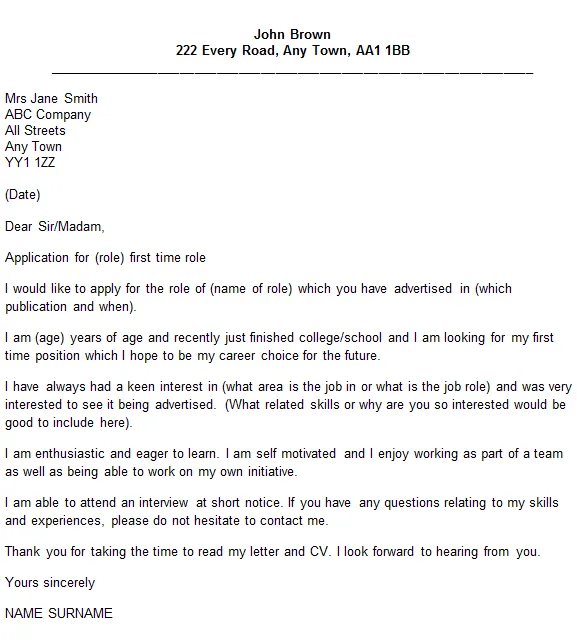
What is a Cover Letter
A cover letter is a crucial document accompanying your resume when applying for a job. It serves as a personalized introduction, allowing you to showcase your personality, skills, and enthusiasm in a way that a resume alone cannot. For those seeking their first job, a well-crafted cover letter is even more vital. It provides an opportunity to address the lack of direct work experience, highlighting transferable skills, academic achievements, and any relevant extracurricular activities. The cover letter is your chance to make a strong first impression and convince the hiring manager that you are a promising candidate. It’s a bridge between your qualifications and the job requirements, showing why you’re the right fit for the role. It’s not just a formality, but a strategic tool in your job search arsenal, setting the tone for your application and increasing your chances of landing an interview.
Why is a Cover Letter Important
In a competitive job market, especially for entry-level positions, a cover letter can set you apart from other applicants. It demonstrates your communication skills, attention to detail, and genuine interest in the specific role and company. While a resume provides a summary of your qualifications, a cover letter allows you to elaborate on those qualifications, explain your career goals, and connect your skills to the job requirements. It shows that you’ve taken the time to research the company and understand the position, indicating your proactive approach and initiative. Furthermore, a cover letter can compensate for a lack of experience by emphasizing your transferable skills, such as communication, teamwork, and problem-solving abilities, that are relevant to the job. It allows you to address any potential gaps in your resume, such as a career change or a period of unemployment, providing context and reassuring the hiring manager.
Essential Components of a First Job Cover Letter

A well-structured cover letter is the key to making a positive first impression. It should be clear, concise, and tailored to each job application. Here are the core elements to include:
Your Contact Information
At the top of your cover letter, include your name, address, phone number, and email address. Make sure your email address is professional. This allows the hiring manager to easily reach you. Ensure the information is accurate and up-to-date.
Date and Recipient Information
Below your contact information, include the date you are writing the letter. Then, include the name of the hiring manager and their title, along with the company name and address if known. If the specific name of the hiring manager isn’t available, use a generic salutation like “Dear Hiring Manager.”
The Salutation

Start your cover letter with a professional salutation. “Dear Mr./Ms./Mx. [Last Name]” is preferred if you know the hiring manager’s name. If not, “Dear Hiring Manager” or “Dear [Department Name] Team” are acceptable alternatives. Avoid overly casual greetings.
Body Paragraph 1 Introduce Yourself
In your opening paragraph, state the position you are applying for and how you found out about it. Briefly mention where you learned about the opportunity, whether it was through a job board, a company website, or a referral. Also, express your enthusiasm for the role and the company. This sets the tone for your application and captures the reader’s attention. Ensure the role is stated, and then show enthusiasm.
Body Paragraph 2 Highlight Skills
This is where you highlight the skills and experiences that make you a good fit for the job. Since you may lack extensive professional experience, focus on transferable skills such as communication, teamwork, problem-solving, and time management. Use examples from your academic projects, extracurricular activities, volunteer work, or part-time jobs to demonstrate these skills. Quantify your achievements whenever possible, such as by mentioning the results of a project or the number of people you worked with on a team. Relate the skills to the job description to illustrate why you’re suitable.
Body Paragraph 3 Showcase Enthusiasm

Demonstrate your passion for the company and the specific role in this paragraph. Explain why you are interested in the company and what attracts you to the position. Show that you have researched the company, its values, and its mission. You can mention something that resonated with you or express how you want to contribute to the team. This section reinforces your enthusiasm, and allows you to display a desire to work in the position offered.
The Closing
Conclude your cover letter with a call to action. Reiterate your interest in the position and express your eagerness to discuss your qualifications further in an interview. Thank the hiring manager for their time and consideration. Use a professional closing such as “Sincerely,” “Best regards,” or “Respectfully,”, followed by your typed name.
Proofreading and Formatting
Proofreading and proper formatting are essential to ensure your cover letter is professional and easy to read. Proofread your letter carefully for any grammatical errors, spelling mistakes, and punctuation issues. Use a spell checker, but also read the letter multiple times to catch any errors that a spell checker might miss. Ensure your formatting is consistent, with a clear and professional font like Times New Roman, Arial, or Calibri. Use a standard font size (11 or 12 points) and maintain consistent margins. Keep the letter concise, ideally one page in length, and use bullet points or short paragraphs to break up long blocks of text. Double-check the recipient’s name and contact information for accuracy.
Common Mistakes to Avoid

Avoiding common mistakes can significantly improve the impact of your cover letter. Do not make generic cover letters; tailor each letter to the specific job and company. Avoid simply repeating your resume; use the cover letter to expand on key skills and experiences. Do not use slang, contractions, or overly casual language. Always proofread carefully to eliminate errors. Avoid negative statements or complaints about previous jobs or employers. Finally, do not exceed one page, keeping your cover letter concise and to the point. Remember to highlight relevant skills and always customize your letter.
Example of a Cover Letter for a First Job
Here is an example of a cover letter for a first job. [Your Name] [Your Address] [Your Phone Number] [Your Email]
[Date] [Hiring Manager Name] (If you know it) [Hiring Manager Title] [Company Name] [Company Address]
Dear [Mr./Ms./Mx. Last Name or Hiring Manager],
I am writing to express my keen interest in the [Job Title] position at [Company Name], as advertised on [Platform where you saw the job]. As a recent graduate with a [Your Degree] from [Your University], I am eager to leverage my skills and contribute to your team.
During my academic career, I developed strong [mention 2-3 relevant skills, e.g., communication, teamwork, problem-solving] skills through various projects. For instance, in my [Project Name] project, I successfully [describe achievement, quantifying it if possible]. I am also a dedicated [mention extracurricular activity or volunteer work], where I gained experience in [mention relevant skills].
I am particularly drawn to [Company Name] because of [mention something specific you admire about the company]. I am enthusiastic about the opportunity to [mention a specific task or goal]. I am confident that my skills and enthusiasm align perfectly with your requirements.
Thank you for considering my application. I look forward to the opportunity to discuss my qualifications further in an interview. I am available at your earliest convenience.
Sincerely, [Your Typed Name]
Final Thoughts
Crafting a compelling cover letter for your first job is a vital step in launching your career. By following the guidelines and tips outlined in this guide, you can create a cover letter that effectively showcases your skills, enthusiasm, and potential to employers. Remember to tailor your cover letter to each job, proofread meticulously, and highlight your transferable skills to compensate for the lack of direct experience. With a well-written cover letter, you will increase your chances of getting noticed and landing an interview, setting you on the path to success. Good luck with your job search!