Highlighting Your CS Skills
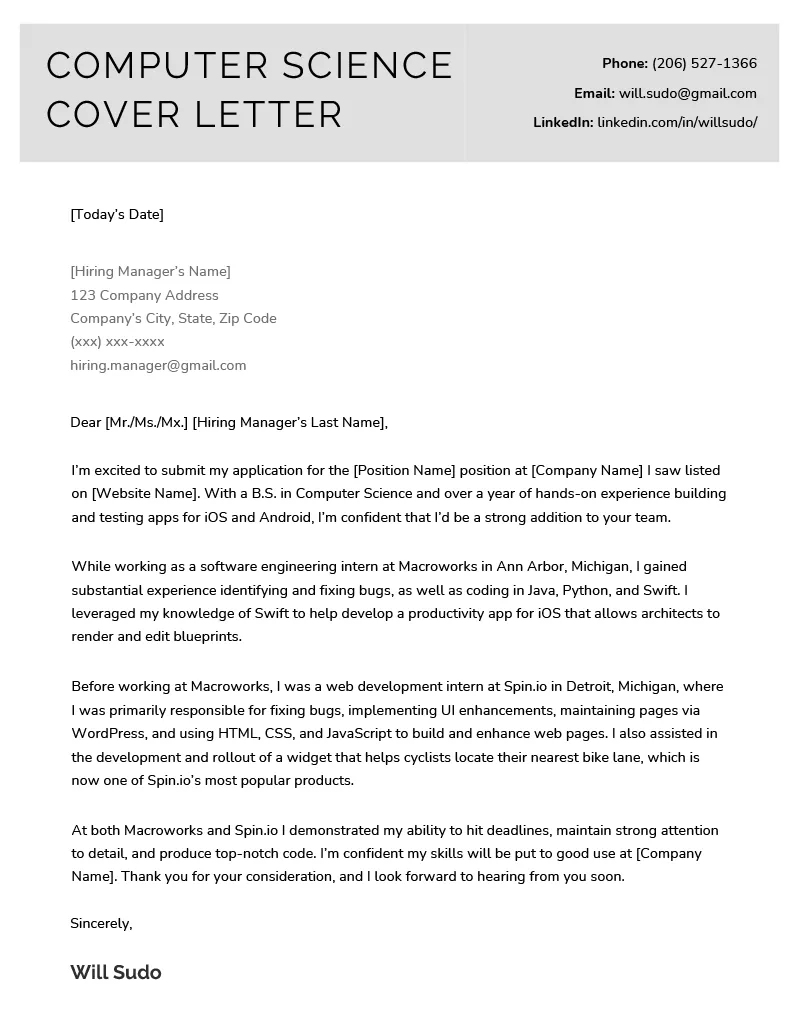
Your cover letter is your first chance to impress a potential employer. When applying for a computer science internship, it’s crucial to showcase your technical skills effectively. Start by listing the programming languages you know, such as Python, Java, C++, or others. Mention relevant software, tools, and frameworks you’re familiar with, like React, Angular, or TensorFlow. Don’t just list the skills; provide context. Explain how you’ve used these skills in projects or coursework. For example, instead of simply writing ‘Python,’ you could say, ‘Proficient in Python, used for developing a machine learning model that improved prediction accuracy by 15%.’ This level of detail demonstrates your practical application of those skills, making your application stand out. Remember to align your skills with the specific requirements mentioned in the internship posting; this personalization shows you’ve paid attention and increases your chances of success. Make it clear, concise, and compelling – your cover letter is your first impression.
Subheading 1: Tailoring Your Cover Letter
One of the most important aspects of a successful cover letter is customization. Generic cover letters often fail because they don’t speak directly to the company or the role. To tailor your letter, carefully review the job description. Identify the key skills, experiences, and qualifications the employer is seeking. Then, in your cover letter, specifically address how your skills and experiences align with those requirements. Mention the company’s name, and if possible, refer to specific projects, initiatives, or values that resonate with you. This shows that you’ve done your homework and that you’re genuinely interested in the opportunity. Moreover, address the specific department or team you’re interested in joining, if mentioned in the job description. This level of personalization demonstrates your genuine interest, which increases the chances of making a favorable impression. Always proofread your letter to ensure that the company’s name and role are correctly referenced.
Showcasing Relevant Projects

For computer science students, projects are a critical part of your portfolio. Your cover letter should highlight any projects that are relevant to the internship you’re applying for. Describe each project concisely, outlining its purpose, your role, and the technologies you used. Focus on the results or outcomes of the projects. Did you solve a specific problem? Did you improve efficiency or performance? Quantify your achievements whenever possible. For instance, instead of saying ‘Developed a website,’ specify ‘Developed a responsive website using HTML, CSS, and JavaScript that increased user engagement by 20%.’ Include a link to your project on GitHub or a personal portfolio site, making it easy for the employer to view your work. This allows potential employers to see your practical skills and the quality of your work. Remember, well-documented projects demonstrate your initiative, technical skills, and ability to solve problems, making you a more attractive candidate.
Subheading 2: Quantifying Your Accomplishments
Quantifying your achievements is a highly effective strategy in a cover letter because it provides concrete evidence of your capabilities and impact. Rather than making vague statements about your skills, support your claims with measurable results. For instance, when describing your projects, use numbers to illustrate your success. Instead of saying ‘Improved code efficiency,’ specify ‘Improved code efficiency by 30% by implementing a new algorithm.’ If you participated in any coding competitions or hackathons, mention your ranking or the awards you received. If you contributed to open-source projects, highlight your contributions and any measurable impact. Quantifiable results demonstrate your impact and provide potential employers with a clear understanding of your abilities. Use metrics to give a clear picture of the value you bring to the table. Always strive to replace general statements with specific, data-driven examples to make your accomplishments more convincing.
Formatting and Structure
The formatting and structure of your cover letter are just as crucial as its content. Ensure your cover letter is easy to read and well-organized. Use a professional font, such as Arial or Times New Roman, with a readable font size (11 or 12 points). Start with your contact information, the date, and the recipient’s details. Begin your cover letter with a compelling opening that captures the reader’s attention and indicates why you are a good fit for the role. Structure the body of your letter with clear paragraphs and headings to guide the reader through your skills, experience, and accomplishments. Use a formal, professional tone throughout the letter. Keep your paragraphs concise, avoiding long blocks of text. A well-formatted cover letter showcases your attention to detail and organizational skills, reflecting positively on your professionalism. The formatting of your letter creates the first impression, making it essential to keep it clean and easy to read.
Subheading 3: Proofreading and Editing

Proofreading and editing your cover letter is a non-negotiable step. A cover letter riddled with errors can create a negative impression, regardless of your qualifications. Proofread your letter carefully for any grammatical errors, spelling mistakes, and typos. Read your cover letter aloud to catch any awkward phrasing or sentence structures. Use spell-check and grammar-check tools, but don’t rely on them completely. These tools might not identify all errors. Ask a friend, professor, or career counselor to review your cover letter for feedback. Fresh eyes can often catch mistakes that you might miss. Ensure that your cover letter flows logically and that your points are clear and concise. Proper proofreading and editing demonstrate your attention to detail and professionalism, which are important qualities that employers look for in computer science professionals.
Conclusion
Crafting a compelling cover letter for a computer science internship requires careful attention to detail and a strategic approach. By highlighting your skills, tailoring your letter to the specific role, showcasing relevant projects, quantifying your accomplishments, and ensuring professional formatting, you can significantly improve your chances of success. Remember to proofread and edit your letter thoroughly. Following these tips, you can create a cover letter that makes a positive impression and sets you apart from the competition. Your cover letter is more than just a document; it’s an opportunity to market yourself effectively and demonstrate your potential to employers. Good luck with your internship applications!