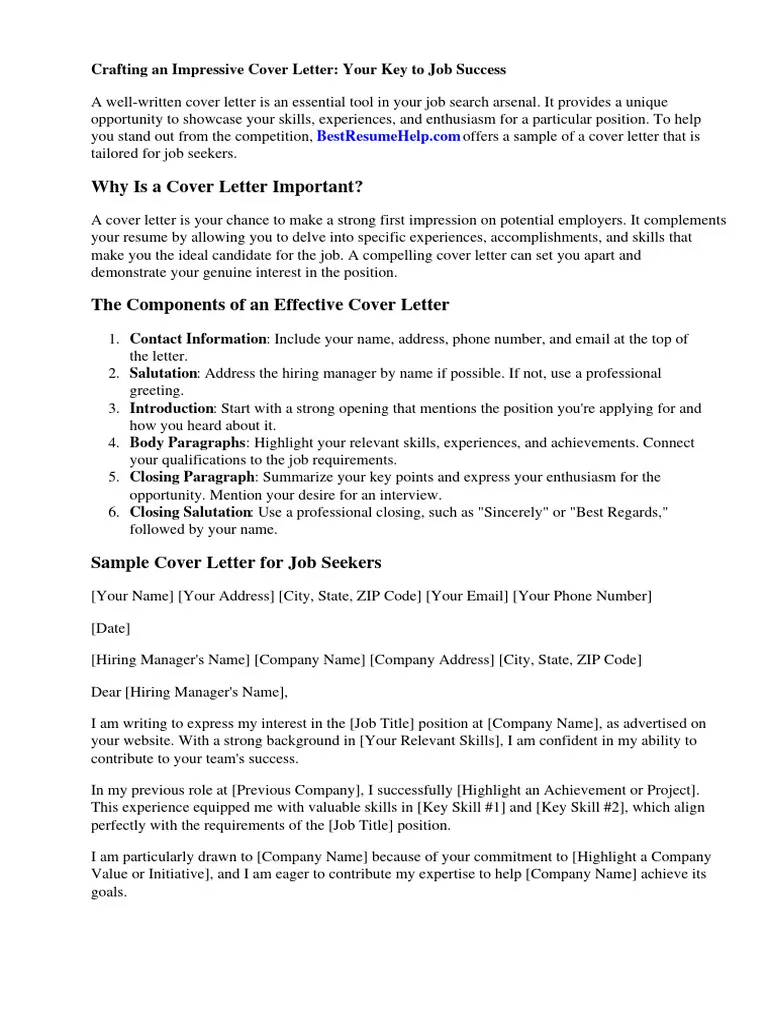
Understanding the Importance of a Cover Letter
In the competitive landscape of job searching, a well-crafted cover letter can be your key to unlocking new opportunities. It is more than just a formality; it’s your first chance to make a strong impression on a potential employer. A cover letter allows you to introduce yourself, showcase your personality, and highlight the specific skills and experiences that make you the ideal candidate. It also serves as an opportunity to demonstrate your enthusiasm for the role and the company. Without a compelling cover letter, your resume might get overlooked. Think of it as your personal sales pitch, a tool designed to persuade the hiring manager to delve deeper into your qualifications and invite you for an interview. A cover letter, therefore, acts as a bridge, connecting your skills with the employer’s needs, ultimately driving you closer to securing your desired position.
Why Cover Letters Matter in Your Job Search
Cover letters provide a platform to tell your story. Resumes, by their nature, are a summary of your experience and qualifications, often lacking the space to elaborate on specific achievements or explain career transitions. Cover letters fill this gap. They enable you to explain your career goals, clarify any gaps in your employment history, and express why you are the perfect fit for the company and the role. They allow you to show, not just tell, the hiring manager why you’re the right person for the job. A well-written cover letter demonstrates your communication skills, attention to detail, and genuine interest in the position. This can significantly increase your chances of moving forward in the hiring process, setting you apart from other applicants.
Cover Letters and Applicant Tracking Systems (ATS)

Many companies use Applicant Tracking Systems (ATS) to manage their hiring processes. These systems scan resumes and cover letters for keywords and phrases that match the job description. Understanding how ATS works is crucial for cover letter success. Tailoring your cover letter to include relevant keywords from the job posting helps your application get past the initial screening stage. It’s important, however, to balance keyword optimization with natural language. The goal is to write a cover letter that both passes through the ATS and appeals to a human reader. Focus on integrating keywords organically within the context of your accomplishments and skills. This ensures your application is noticed while still maintaining a professional and engaging tone.
Top 5 Cover Letter Tips
Tailor Your Cover Letter to Each Job
One size does not fit all when it comes to cover letters. Generic cover letters are easily identifiable and often discarded. Customizing your cover letter for each job application is essential. This demonstrates that you’ve taken the time to understand the specific requirements of the role and the values of the company. Tailoring includes researching the company, identifying the key skills and experiences they’re looking for, and then highlighting your relevant qualifications. This approach shows employers that you are genuinely interested in their organization and understand what the job entails. By personalizing your cover letter, you increase your chances of making a positive impression and advancing to the next stage of the hiring process.
Research the Company and Role

Before you start writing, thoroughly research the company and the specific role. Understand their mission, values, and recent activities. Visit their website, read news articles, and explore their social media presence. This will give you insights into their culture and what they value in employees. Next, analyze the job description closely. Identify the key skills, experiences, and qualifications the employer is seeking. Look for keywords and phrases that you can incorporate into your cover letter. By understanding the company and the role, you can tailor your letter to demonstrate how your skills and experiences align with their needs and objectives.
Highlight Relevant Skills and Experiences
Once you understand the job requirements, focus on highlighting the skills and experiences that match. Review your resume and identify the accomplishments that best align with the job description. Then, select the most relevant examples and incorporate them into your cover letter. Provide specific examples of how you’ve demonstrated these skills in the past. Use the STAR method (Situation, Task, Action, Result) to structure your responses. Describe the situation, the task you were assigned, the action you took, and the positive results you achieved. This approach gives the hiring manager a clear understanding of your capabilities and the impact you can make in the role.
Use Keywords from the Job Description
As mentioned earlier, Applicant Tracking Systems (ATS) are used by many companies. Incorporating keywords from the job description can help your application get past the initial screening. Identify the key skills, qualifications, and phrases used in the job posting. Then, weave these keywords naturally into your cover letter. Be careful not to overdo it. The goal is to ensure your letter is both ATS-friendly and engaging for a human reader. The right balance will ensure that your application gets noticed and that your qualifications are clearly communicated.
Showcase Your Achievements with Numbers

Instead of simply listing your responsibilities, use your cover letter to demonstrate your achievements. Quantifying your accomplishments with numbers and data makes them more impactful and memorable. It provides concrete evidence of your abilities and the value you can bring to the company. When possible, use numbers to illustrate your impact on previous employers. This can include statistics like the percentage increase in sales, the number of projects completed, or the amount of money saved. Quantifiable achievements demonstrate your value and show potential employers the results you’re capable of delivering.
Quantify Your Accomplishments
Quantifying your accomplishments involves using numbers and data to illustrate your achievements. For instance, instead of saying you ‘improved customer satisfaction,’ say ‘increased customer satisfaction scores by 15%.’ Instead of stating you ‘managed social media accounts,’ describe how you ‘grew the company’s social media following by 2000 followers in six months’. When quantifying, be specific and accurate. Use metrics that are relevant to the job description and the company’s goals. Highlighting measurable results leaves a stronger impression and provides clear evidence of your capabilities and the value you can bring to the position. Quantifiable achievements demonstrate the impact of your work and help you stand out from the competition.
Use Action Verbs
Action verbs breathe life into your cover letter. They make your accomplishments more engaging and demonstrate your skills and experience. Instead of using passive language, such as ‘responsibilities included,’ opt for active verbs like ‘managed,’ ’led,’ ‘developed,’ ‘achieved,’ or ‘implemented.’ Start each bullet point or sentence with a strong action verb to create a dynamic and compelling narrative. Examples include ‘Spearheaded,’ ‘Orchestrated,’ ‘Optimized,’ or ‘Innovated.’ Using strong action verbs helps you make a more memorable impression and conveys your capabilities more effectively. This ensures your cover letter captures the reader’s attention and highlights your accomplishments.
Keep it Concise and Engaging

Hiring managers are often pressed for time, so it’s crucial to keep your cover letter concise and engaging. Aim for a length of one page, and focus on providing the most relevant information. Use clear, concise language and avoid jargon or overly complex sentences. Structure your letter logically with a clear introduction, body, and conclusion. Keep each paragraph focused on a single idea. Use strong opening sentences to grab the reader’s attention. Maintain a professional and enthusiastic tone throughout the letter. Proofread carefully to ensure your letter is free of errors. A well-written, concise cover letter quickly communicates your value and increases your chances of securing an interview.
Formatting and Structure
The formatting of your cover letter is just as important as its content. A well-formatted letter is easy to read and makes a positive impression. Use a professional font such as Times New Roman, Arial, or Calibri, and ensure that your font size is easy to read. Maintain consistent formatting throughout the document. Use appropriate headings and subheadings to break up large blocks of text and improve readability. Ensure consistent margins and spacing. Proofread your cover letter to identify and correct any formatting inconsistencies. Formatting can include using bullet points for highlighting key skills, experiences, or achievements. A well-formatted letter makes it easier for the hiring manager to read and quickly grasp your qualifications.
Proofread Carefully
Proofreading is a crucial step in the cover letter writing process. Errors in grammar, spelling, and punctuation can create a negative impression and undermine your credibility. Take the time to carefully review your cover letter for any mistakes. Read it aloud to catch any awkward phrasing or grammatical errors. Use a grammar and spell checker to identify potential issues. It’s also helpful to have a friend or colleague review your letter. A fresh pair of eyes can often spot errors that you might have missed. Thoroughly proofread your cover letter to ensure it’s polished, professional, and error-free.
Include a Strong Call to Action

A strong call to action encourages the hiring manager to take the next step. In your cover letter, clearly express your interest in the role and reiterate your desire to discuss your qualifications further. Suggest a specific action you want the reader to take, such as ‘I am eager to discuss how my skills can benefit your team. I am available for an interview at your earliest convenience.’ Provide your contact information so it’s easy for the hiring manager to reach you. By including a strong call to action, you increase your chances of being contacted for an interview.
Express Enthusiasm and Interest
Your cover letter is the perfect place to showcase your enthusiasm for the role and the company. Let your passion shine through in your writing. Explain why you are excited about the opportunity and how your skills and experiences align with the company’s needs. Demonstrate your understanding of the company’s mission and values, and explain why you want to contribute. Be genuine in your expression of interest. A genuine display of enthusiasm can make a lasting impression and set you apart from other applicants. The goal is to convince the reader that you are truly invested in the position and the organization.
Provide Contact Information and Next Steps
Make it easy for the hiring manager to contact you. Provide your full name, phone number, email address, and LinkedIn profile URL (if applicable). Ensure that your contact information is accurate and up-to-date. Clearly state your availability for an interview and express your willingness to discuss your qualifications further. Be professional and polite in your closing. Thank the reader for their time and consideration. A clear call to action and well-organized contact information will increase the chances of the hiring manager contacting you for an interview.
Common Mistakes to Avoid

Generic Cover Letters
Generic cover letters are easily recognizable and make a negative impression. They fail to show the hiring manager that you’ve taken the time to understand the specific requirements of the role or the company’s values. Avoid using a template without tailoring it to the specific job. The best cover letters demonstrate that you’ve researched the company and the role, and that you understand what the employer is looking for. Instead of generic statements, use specific examples that highlight your skills and accomplishments. Personalize your cover letter to make a positive impression and increase your chances of being contacted for an interview.
Typos and Grammatical Errors
Typos and grammatical errors can undermine your credibility and make it difficult for the hiring manager to take your application seriously. They suggest a lack of attention to detail and a lack of professionalism. Always proofread your cover letter carefully for any mistakes. Use a grammar and spell checker to identify potential issues. Read your letter aloud to catch any awkward phrasing or grammatical errors. Ask a friend or colleague to review your letter as well. Errors are easily corrected, but can have a huge impact on your chances of securing an interview.
Focusing Too Much on Yourself

A cover letter should focus on how you can benefit the employer, not just on your own needs and wants. While it’s important to highlight your skills and experiences, it’s equally important to demonstrate how you can contribute to the company’s success. Avoid focusing solely on your accomplishments without explaining how they align with the job description. Instead, tailor your cover letter to show how your skills and experiences match the needs of the company and the role. Explain how you can add value and contribute to the company’s goals. The objective is to show that you are not just qualified, but also the best fit for the organization.
Closing Thoughts
Writing a compelling cover letter takes time and effort, but the investment is well worth it. By following these tips, you can create a cover letter that grabs the hiring manager’s attention and sets you apart from other applicants. Tailor your cover letter to each job, highlight your skills and experiences, and showcase your achievements. Proofread carefully and include a strong call to action. A well-crafted cover letter is a powerful tool in your job search, significantly boosting your chances of securing an interview and ultimately, landing your dream job.