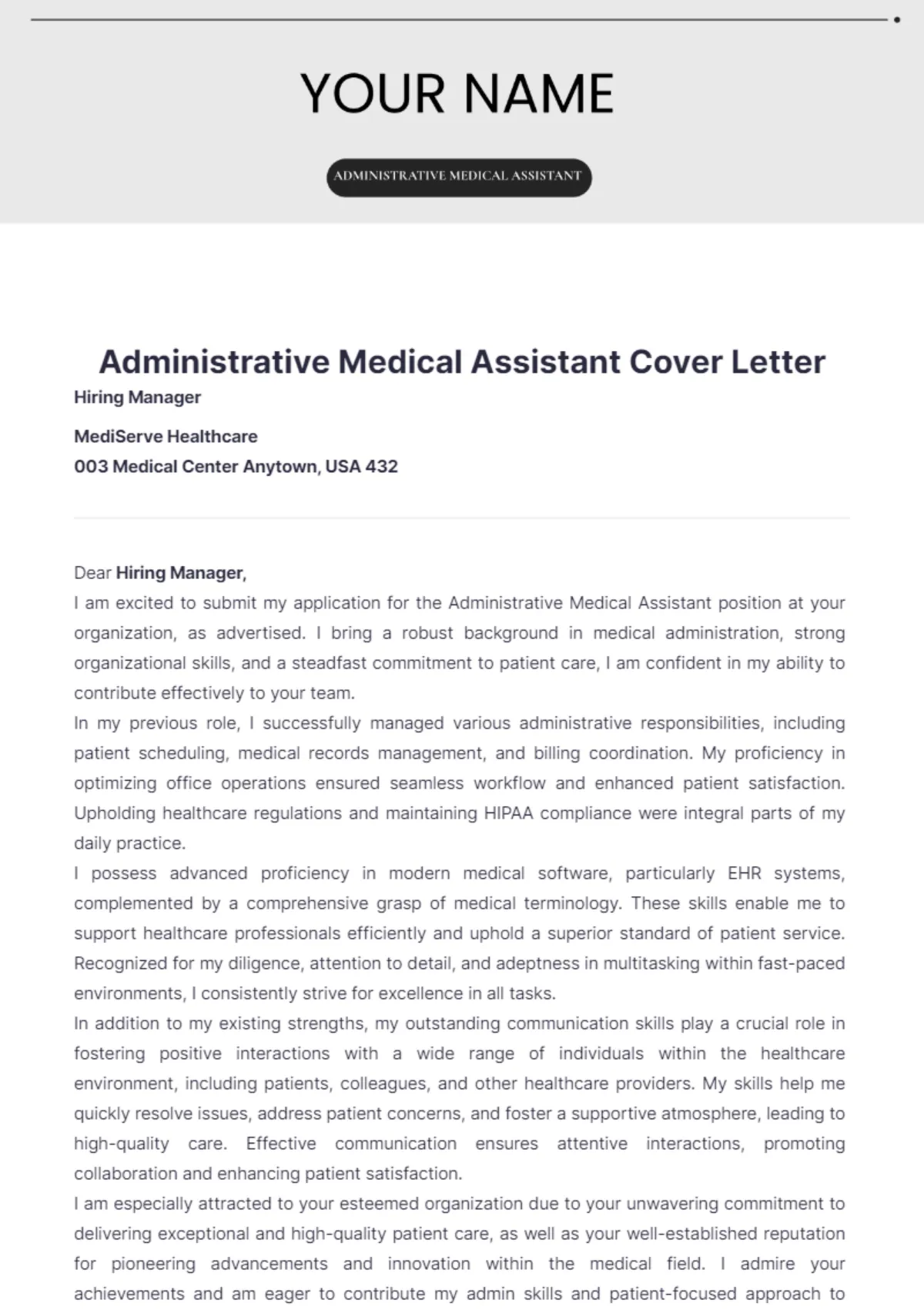
Medical Office Assistant Cover Letter: Essential Elements
A well-crafted cover letter is your first impression on a potential employer, especially in the competitive field of medical office assisting. It provides an opportunity to showcase your qualifications, enthusiasm, and suitability for the role. This guide will break down the essential elements of a medical office assistant cover letter, offering a sample and practical tips to help you create a compelling document that grabs attention and increases your chances of landing an interview. By understanding these key components, you can effectively communicate your skills and experience, making a strong case for why you are the ideal candidate. Remember, a tailored cover letter is not just a formality; it’s a strategic tool in your job search arsenal.
Contact Information
Accuracy and clarity are paramount in this section. Ensuring your contact information is correct allows the employer to easily reach you. It’s a professional courtesy to include all the necessary details, making the process of contacting you straightforward and efficient. Double-checking this section is a simple step that can prevent potential delays or missed opportunities. Always proofread and confirm that every piece of information is current and correct before submitting your cover letter.
Your Full Name & Contact Details

Start with your full name, followed by your phone number, email address, and optionally, your LinkedIn profile URL or professional website. Use a professional email address – avoid informal or outdated ones. This information should be clearly displayed at the top, left-aligned, and formatted in a clean and easy-to-read manner. Your phone number should be current, and your voicemail should be set up professionally, ready to receive messages.
Employer’s Contact Information
Below your information, include the employer’s contact details. This typically includes the hiring manager’s name (if known), their title, the company name, and the company’s address. If you are responding to a job posting, this information is usually provided. If not, research the company’s website or LinkedIn to find the relevant contact details. Addressing your letter to a specific person, rather than a generic ‘To Whom It May Concern,’ demonstrates that you’ve done your research and are genuinely interested in the position.
Professional Greeting
Start your letter with a professional greeting. If you know the hiring manager’s name, use ‘Dear Mr./Ms./Mx. [Last Name]’. If you don’t know the name, you can use ‘Dear Hiring Manager’ or ‘Dear [Department Name] Hiring Team’. Avoid generic greetings like ‘To Whom It May Concern’, as they can make your letter seem impersonal. Maintain a formal tone throughout the greeting, ensuring you make a positive first impression.
The Body Paragraphs

The body paragraphs are where you make your case for why you are the right candidate. This section allows you to elaborate on your qualifications, skills, and experiences. It’s an opportunity to showcase your personality and enthusiasm for the role. Structure your body paragraphs logically, using clear and concise language. Aim to create a compelling narrative that highlights your strengths and aligns them with the requirements of the medical office assistant position. Each paragraph should have a specific purpose and contribute to the overall impact of your cover letter.
Opening Paragraph
The opening paragraph should immediately capture the reader’s attention and state your purpose. Clearly mention the specific position you are applying for and where you found the job posting. Briefly express your interest in the role and the company. This paragraph sets the tone for your entire letter and encourages the reader to continue. Make it concise, enthusiastic, and focused on the value you bring to the position. This paragraph should also showcase your personality and your excitement for the role, and it should demonstrate that you understand the role and the company’s values.
Expressing Interest and Identifying the Job
Begin by stating the specific medical office assistant position you are applying for. Be precise and mention where you saw the job posting (e.g., Indeed, company website). This helps the hiring manager quickly understand which position you’re interested in. Following this, express your strong interest in the role and the company. Mentioning something specific about the company that resonates with you, such as their mission or values, can further demonstrate your genuine interest. This initial statement should immediately grab the reader’s attention and set the stage for the rest of the letter.
Highlighting Relevant Skills and Experience

The heart of your cover letter is where you showcase your skills and experience. Focus on the skills that are most relevant to the medical office assistant position, such as patient interaction, appointment scheduling, insurance verification, and electronic health records (EHR) management. Use specific examples from your past experiences to illustrate your abilities. This is where you can demonstrate the value you can bring to the role. Ensure that the skills you highlight match the requirements listed in the job description. Tailor your content to each specific job application to maximize your impact.
Showcasing Skills
Identify the key skills required for the medical office assistant role and provide examples of how you have utilized those skills in the past. Mention your proficiency in handling patient inquiries, managing appointments, and processing insurance claims. If the job description emphasizes specific software or systems (e.g., EHR software), highlight your experience with those tools. When describing your skills, focus on their impact. For instance, instead of saying, ‘I managed patient files’, say, ‘Successfully managed and maintained patient files, resulting in improved organizational efficiency and accuracy’.
Quantifying Achievements
Whenever possible, quantify your achievements to demonstrate the impact of your skills. For example, instead of saying, ‘Improved patient satisfaction’, state, ‘Increased patient satisfaction scores by 15% through improved communication and follow-up’. Use numbers, percentages, and specific metrics to showcase your accomplishments. Quantifying your achievements makes your cover letter more compelling and provides concrete evidence of your abilities. Consider using the STAR method (Situation, Task, Action, Result) to structure your examples and make them even more impactful.
Closing Paragraph

The closing paragraph should reiterate your interest and include a call to action. Briefly summarize your qualifications and express your enthusiasm for the opportunity. Thank the reader for their time and consideration. Provide a clear call to action, such as stating that you are available for an interview and how they can contact you. This paragraph serves as a final reminder of your value and ensures that the hiring manager knows how to proceed with your application.
Reiterate Interest and Call to Action
In your closing paragraph, restate your strong interest in the medical office assistant position and the company. Briefly summarize why you are a good fit for the role, emphasizing your key skills and experience. End with a clear call to action, such as ‘I am eager to discuss how my skills and experience can contribute to your team. I am available for an interview at your earliest convenience’ and include your contact information. Thank the hiring manager for their time and consideration, demonstrating your professionalism and appreciation.
Proper Formatting and Structure
The formatting and structure of your cover letter are as important as the content. A well-formatted cover letter is easy to read and demonstrates professionalism. Poor formatting can distract the reader and detract from your qualifications. Always use a clear and consistent format. Pay attention to the font, spacing, and margins to create a visually appealing document. This attention to detail shows your commitment to quality and your professionalism as a candidate.
Font and Font Size

Choose a professional and readable font, such as Times New Roman, Arial, Calibri, or Helvetica. Avoid using unusual or overly decorative fonts. Ensure the font size is between 10 and 12 points for easy readability. Maintain consistency throughout the document. Using a standard font and size makes your cover letter look polished and professional, ensuring the reader can easily focus on your message.
Margins and Spacing
Set your margins to 1 inch on all sides. Use single-line spacing within paragraphs and double-line spacing between paragraphs. This spacing ensures that your cover letter is easy to read and visually appealing. Proper spacing prevents your document from looking cramped, allowing the reader to comfortably absorb the information. Consistent formatting enhances the overall professionalism of your cover letter.
Proofreading and Editing
Before submitting your cover letter, carefully proofread and edit it. Errors in grammar, spelling, and punctuation can undermine your credibility and make you appear unprofessional. Taking the time to thoroughly review your letter demonstrates attention to detail, which is a critical skill for a medical office assistant. Always review your cover letter for clarity, accuracy, and professionalism before submitting it with your application.
Reviewing for Errors

Carefully review your cover letter for any spelling, grammar, and punctuation errors. Use a spell-checker and grammar-checker, but don’t rely on them entirely. Read your cover letter aloud to catch any awkward phrasing or mistakes. Look for consistency in tense, formatting, and capitalization. Errors, no matter how small, can give a negative impression. Correcting these ensures your professionalism and attention to detail.
Seeking Feedback
Ask a friend, family member, or career advisor to review your cover letter. An outside perspective can help you identify any mistakes or areas for improvement that you might have missed. Ask them to assess the clarity of your writing, the flow of your ideas, and the overall impact of your letter. Getting feedback provides a fresh perspective and helps you refine your cover letter to maximize its effectiveness. Take their suggestions into account and make the necessary revisions.
Medical Office Assistant Cover Letter Sample: Finalizing
After you’ve reviewed and refined your cover letter, it’s time to finalize it. Ensure your cover letter is tailored to the specific job description and company requirements. Save your cover letter in a professional format, such as a PDF, to preserve its formatting and make sure it appears the same on any computer. By following these guidelines, you can create a compelling medical office assistant cover letter that highlights your strengths and increases your chances of getting an interview.