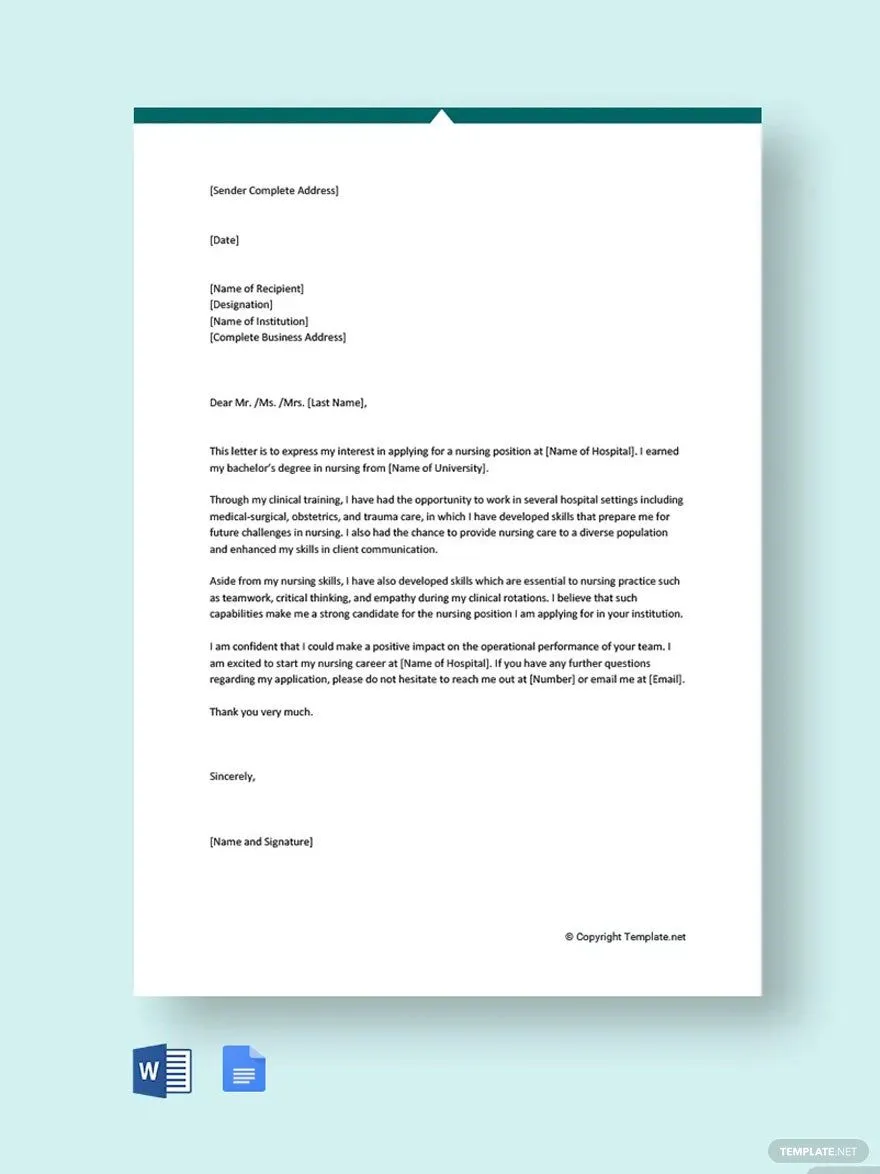
What is a Nurse Cover Letter?
A nurse cover letter is a professional document that accompanies your resume when applying for nursing positions. It serves as your first introduction to the hiring manager, providing a concise overview of your skills, experience, and qualifications. Unlike a resume, which provides a factual account of your work history, a cover letter allows you to express your personality, demonstrate your passion for nursing, and explain why you are the perfect fit for the specific role and the healthcare organization. A well-crafted cover letter is a crucial tool in helping you stand out from other applicants and increasing your chances of securing an interview.
Why is a Cover Letter Important for Nurses?
In the competitive field of nursing, a cover letter is not merely optional; it’s essential. It provides an opportunity to highlight the most relevant aspects of your experience and explain how your skills align with the specific requirements of the job. It shows the hiring manager that you’ve taken the time to tailor your application to their needs and are genuinely interested in the position. Furthermore, it allows you to address any potential gaps in your resume, such as a career change or a period of unemployment, and to articulate your career goals and aspirations. A well-written cover letter demonstrates your communication skills, attention to detail, and professional writing abilities, all of which are highly valued in the nursing profession. It allows to convince the hiring manager about your skills.
Key Components of a Nurse Cover Letter

A strong nurse cover letter comprises several key components that work together to create a compelling narrative. These elements include your contact information, a professional greeting, a captivating opening paragraph, a section highlighting your skills and experience, quantifiable achievements, a tailored message to the job description, a demonstration of your passion for nursing, a clear closing paragraph with a call to action, and a formal expression of gratitude. Each section plays a vital role in presenting a well-rounded and persuasive argument for your candidacy. Understanding each part and writing them carefully is essential to make the letter stand out.
Contact Information and Date
At the top of your cover letter, include your full name, address, phone number, and professional email address. Ensure this information is accurate and up-to-date. Following your contact information, include the date of writing. If known, add the hiring manager’s name and title, and the healthcare facility’s address. This level of detail demonstrates that you’ve taken the time to research the position and the organization, further showing your commitment to the opportunity. Making sure that the details are correct and updated are very important.
Professional Greeting
Begin your cover letter with a professional greeting. If you know the hiring manager’s name, use it; “Dear Mr./Ms./Dr. [Last Name]” is a good option. If you are unsure of the hiring manager’s name, you can use a general greeting like “Dear Hiring Manager.” Avoid generic greetings such as “To Whom It May Concern.” This personalized touch shows you’ve done your research and are committed. The professional greeting sets the tone of your cover letter and establishes a respectful and formal tone.
Opening Paragraph Grabbing Attention

Your opening paragraph should immediately grab the reader’s attention. State the specific position you’re applying for and where you saw the job posting. Briefly mention your most impressive qualification or a key achievement that directly relates to the job requirements. The goal is to create a positive first impression and encourage the reader to continue reading. This opening paragraph should be concise, enthusiastic, and focused on highlighting the value you bring to the table. Make the reader want to know more about you.
Highlighting Skills and Experience
The main body of your cover letter should highlight your skills and experience relevant to the nursing position. Use specific examples to demonstrate your abilities, focusing on how your skills align with the job description’s requirements. Provide evidence of your clinical expertise, such as experience in a particular specialty, proficiency in various medical procedures, or knowledge of patient care protocols. Showcase your soft skills, such as communication, teamwork, problem-solving, and critical thinking, and how they benefit the workplace. Tailor the language used to reflect the job requirements and use keywords from the job description to emphasize your qualifications.
Quantifiable Achievements
Whenever possible, quantify your achievements with specific numbers and data. For example, instead of saying you improved patient satisfaction, state that you increased patient satisfaction scores by a certain percentage. If you have reduced medication errors, provide the numerical reduction. Using metrics makes your accomplishments more tangible and demonstrates the impact you have made in previous roles. Quantifiable achievements are more compelling and provide concrete evidence of your capabilities.
Tailoring to the Job Description

Customize your cover letter for each job application. Carefully review the job description and identify the key requirements and desired skills. Address these requirements directly in your cover letter, providing examples of how your skills and experience match the employer’s needs. Show that you have done your research and are genuinely interested in the specific role and the healthcare organization. Show how your skills and experiences are the best for the job position.
Demonstrating Passion for Nursing
Express your passion for nursing and patient care. Explain why you chose nursing as a career and what motivates you. Share your professional goals and aspirations, and how this particular position aligns with your career path. Demonstrate your understanding of the healthcare organization’s mission and values, and how you can contribute to their goals. Your passion can make you a memorable candidate. This passion makes the employer know that you have passion for nursing.
Closing Paragraph and Call to Action
In your closing paragraph, summarize your key qualifications and reiterate your interest in the position. Include a call to action, such as requesting an interview or expressing your availability for a phone call. Make it easy for the hiring manager to take the next step by providing your contact information again. This active approach shows your eagerness and initiative, leaving a positive lasting impression. Make the process easy for the hiring manager to take the next step.
Expressing Gratitude and Offering Contact

Conclude your cover letter by expressing gratitude for the hiring manager’s time and consideration. Thank them for the opportunity to apply for the position and reiterate your enthusiasm for the role. Offer your contact information, including your phone number and email address, and indicate your availability for an interview. A simple “Thank you for your time and consideration. I look forward to hearing from you soon” is a respectful way to end your letter. Offer your phone number and email to contact you.
Formatting and Design Tips
The formatting and design of your cover letter are just as important as its content. Use a clean and professional font, such as Arial, Calibri, or Times New Roman, with a font size between 10 and 12 points. Ensure that your letter is well-organized, with clear headings and plenty of white space. Avoid using distracting colors, graphics, or excessive formatting. Keep your letter concise and easy to read. Use bullet points to break up long blocks of text and to highlight key skills and achievements. Make sure the letter is clear and easy to read.
Choosing the Right Font and Layout
Select a font that is easy to read and professional. Fonts like Times New Roman, Arial, and Calibri are excellent choices because they are universally accepted and do not distract from the content. Use a standard layout with one-inch margins on all sides. Left-align your text and use single spacing within paragraphs and double spacing between paragraphs. Ensure that your letter fits on one page. A well-formatted letter demonstrates professionalism and attention to detail.
Proofreading and Editing

Before submitting your cover letter, proofread it carefully for any grammatical errors, typos, or inconsistencies. Read your letter aloud to catch any awkward phrasing or unclear sentences. Have a friend or colleague review your letter for feedback. A polished cover letter that is free of errors demonstrates your professionalism and attention to detail. Double-check all details, including the hiring manager’s name, the company’s address, and the job title, to ensure accuracy. Correcting all mistakes will increase your chances of getting the job.
Free Nurse Cover Letter Templates to Download
Using a free nurse cover letter template can save you time and effort while ensuring that you include all the essential components. Many websites offer downloadable templates that are customizable to your specific experience and the job you’re applying for. These templates provide a structured format, helping you organize your thoughts and highlight your most relevant qualifications. Consider using different templates depending on your experience. There are templates for entry-level, experienced, and specialized nurses. These are the most recommended:
Template 1 Entry-Level Nurse
If you are a recent graduate or have limited nursing experience, focus on your education, clinical rotations, and any volunteer work. Highlight your skills, such as patient care, medication administration, and communication. Emphasize your enthusiasm and willingness to learn and grow in the nursing profession. Mention any certifications or licenses you have obtained. You might want to include some examples of your skills. For example, mentioning your work at clinical rotations.
Template 2 Experienced Nurse

For experienced nurses, showcase your clinical expertise, leadership skills, and professional accomplishments. Provide specific examples of how you have contributed to patient outcomes and improved healthcare practices. Highlight your experience in different specialty areas, such as critical care, emergency room, or surgical nursing. Include any awards or recognition you have received. You might include some examples of the things that you have done to improve your department.
Template 3 Nurse Practitioner
Nurse Practitioners (NPs) should emphasize their advanced education, clinical skills, and ability to provide comprehensive patient care. Highlight your experience in diagnosing and treating illnesses, ordering and interpreting diagnostic tests, and prescribing medications. Showcase your leadership skills and any experience in managing a patient care team. Focus on your ability to work independently and collaboratively to meet patient needs. Including your responsibilities and experience on the job is very important.
Tips for Customizing Your Cover Letter
When using a template, customize it to fit the specific job description. Tailor your skills and experience to the job requirements and use the keywords from the job posting. Highlight your accomplishments and quantify them whenever possible. Make sure your letter reflects your unique personality and the values of the healthcare organization. Your customized cover letter will demonstrate your attention to detail and your genuine interest in the position.
Keywords and Phrases to Include
Use relevant keywords and phrases throughout your cover letter to optimize it for applicant tracking systems (ATS). These systems scan your application for specific terms and phrases, helping to identify qualified candidates. Review the job description and identify the keywords used to describe the required skills and experience. Incorporate these keywords naturally into your cover letter, highlighting your qualifications in a way that aligns with the employer’s needs. Try to find the keywords from the job description and add it to the cover letter.
Common Mistakes to Avoid
Avoid making these common mistakes: generic cover letters, typos and grammatical errors, overly long letters, focusing solely on your needs, and using negative language. Make sure the letter addresses the specific job requirements. Always proofread your letter before submitting it. Highlight how you can contribute to the organization. This will make your letter stand out. Be positive about the job, be sure to know about the employer’s requirements, and be as specific as you can.
Final Checklist Before Submission
Before submitting your cover letter, review this final checklist: Ensure your contact information is correct. Address the letter to the correct person. Tailor the letter to the job description. Proofread for any errors. Use a professional format and font. Include a call to action. Express gratitude for their time. If all these are completed, then you are ready to send your letter. After reviewing the checklist, you can submit your cover letter to get the job.