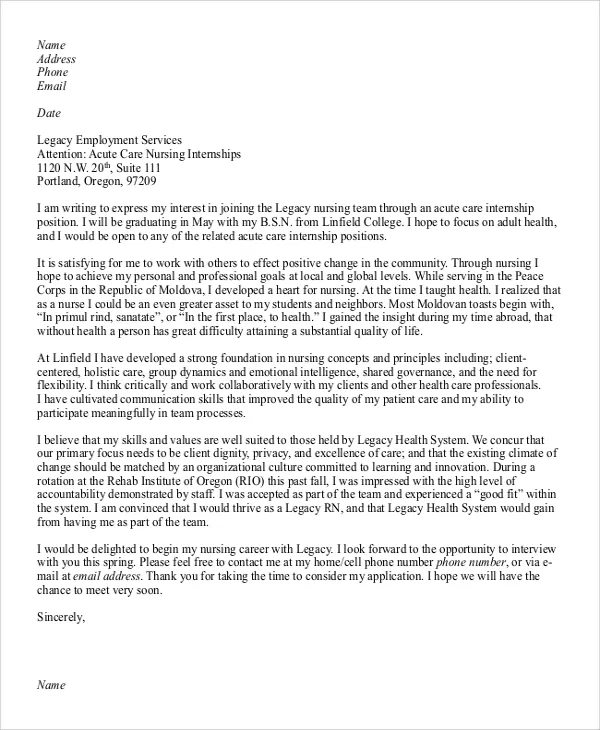
Crafting the Perfect Nursing Cover Letter
A well-crafted nursing cover letter is your first impression on a potential employer. It’s your chance to showcase your skills, experiences, and passion for nursing in a concise and compelling manner. This document is more than just a formality; it’s a critical tool in your job search. A strong cover letter grabs the hiring manager’s attention and encourages them to delve deeper into your resume. It tells your story, highlighting your unique value proposition as a nurse. Ignoring this crucial step can significantly decrease your chances of landing your dream job. The cover letter is your personal introduction, so it should reflect your personality and career goals. Tailoring the letter to each specific job and showing genuine enthusiasm for the role is vital. A generic, impersonal cover letter often ends up in the rejection pile. Think of your cover letter as a marketing tool, where you’re selling yourself and your skills.
Highlight Your Key Skills and Experiences
Your nursing cover letter must clearly highlight your relevant skills and experiences. Focus on the abilities that directly relate to the job requirements outlined in the job description. This helps the hiring manager quickly understand how you match the role’s needs. Start by listing the essential skills, such as patient care, medication administration, critical thinking, and electronic health record (EHR) proficiency. Then, support each skill with specific examples from your previous experiences. If the job requires experience in a particular specialty, such as critical care or pediatrics, emphasize this in your cover letter. Include any certifications, such as BLS, ACLS, or specialized certifications, that are relevant to the position. Quantify your skills whenever possible; for instance, mention the number of patients you’ve cared for or the types of procedures you’ve performed. Remember, the goal is to demonstrate that you not only have the necessary skills but also possess practical experience that makes you an ideal candidate.
Showcase Your Achievements and Quantify Them

Don’t just list your responsibilities; showcase your achievements. Hiring managers want to see how you’ve made a difference in your previous roles. Start by identifying your key accomplishments in your nursing career. Did you implement a new patient care protocol that improved outcomes? Did you train new nurses? Did you receive any awards or recognition? When describing your achievements, use the STAR method – Situation, Task, Action, Result. For example, instead of saying “Managed patient care,” you could say, “In a high-pressure ICU setting (Situation), I was tasked with managing the care of 10 critically ill patients (Task). I implemented a new monitoring system and improved communication protocols (Action), which resulted in a 15% reduction in patient readmission rates and improved patient satisfaction scores (Result).” This approach helps the employer visualize your contributions. Always quantify your achievements with data, such as percentages, numbers, or specific outcomes. Numbers bring your achievements to life and show the impact you had in your previous roles. By quantifying your achievements, you can transform a generic statement into a compelling narrative.
Demonstrate Your Passion for Nursing
Your passion for nursing should shine through your cover letter. This is an opportunity to show the employer why you chose this career path and what motivates you. Begin by expressing your genuine interest in the specific nursing position and the healthcare organization. Show that you understand the organization’s mission, values, and patient care philosophy. Explain what specifically attracts you to this opportunity and how your values align with theirs. Give specific examples of what makes you excited about nursing. Do you enjoy helping patients, collaborating with a team, or constantly learning new skills? Share a brief anecdote or experience that reflects your dedication to nursing. Mention your career goals and how this position will help you achieve them. Express your enthusiasm for patient care, your commitment to providing compassionate care, and your desire to contribute to a positive work environment. A genuine, heartfelt cover letter makes a strong impression. It showcases you as a caring and dedicated professional, making the hiring manager more inclined to interview you.
Customize Your Cover Letter for Each Position
Avoid using a generic cover letter. Tailoring your cover letter to each specific job application is crucial for success. Start by carefully reviewing the job description and identifying the key requirements and preferred qualifications. Then, customize your letter to align with these requirements. Highlight the skills and experiences that match the job description. Address specific needs or challenges mentioned by the employer. Demonstrate that you understand the role’s responsibilities and the healthcare organization’s mission. Research the organization. This means knowing what they do. If they promote specific practices, such as patient advocacy, or innovative technologies, mention it in your letter. Modify the language and tone to match the organization’s culture. The more personalized your letter, the more likely it will stand out. Tailoring the letter shows that you care about the role and are willing to put in the effort to match the company’s requirements and values. Make sure to update it for each application, adding the specific details that are relevant to each position.
Proofread and Edit Your Cover Letter

Proofreading and editing are the final, critical steps in creating a professional nursing cover letter. Carefully review your cover letter for any grammatical errors, spelling mistakes, or typos. Typos can undermine your credibility. Check the letter’s formatting, ensuring it is clear, concise, and easy to read. Use a professional font and appropriate spacing. Ensure the letter is free of punctuation errors and follows standard business letter format. Read your cover letter aloud to catch any awkward phrasing or sentences. Consider asking a friend, mentor, or career advisor to review your cover letter and give feedback. Another set of eyes can catch errors. Verify all contact information, including your name, address, phone number, and email address. Make sure all information is correct and up-to-date. A flawless cover letter reflects your attention to detail and professionalism, making a positive first impression on potential employers. A well-edited cover letter can significantly increase your chances of getting an interview.