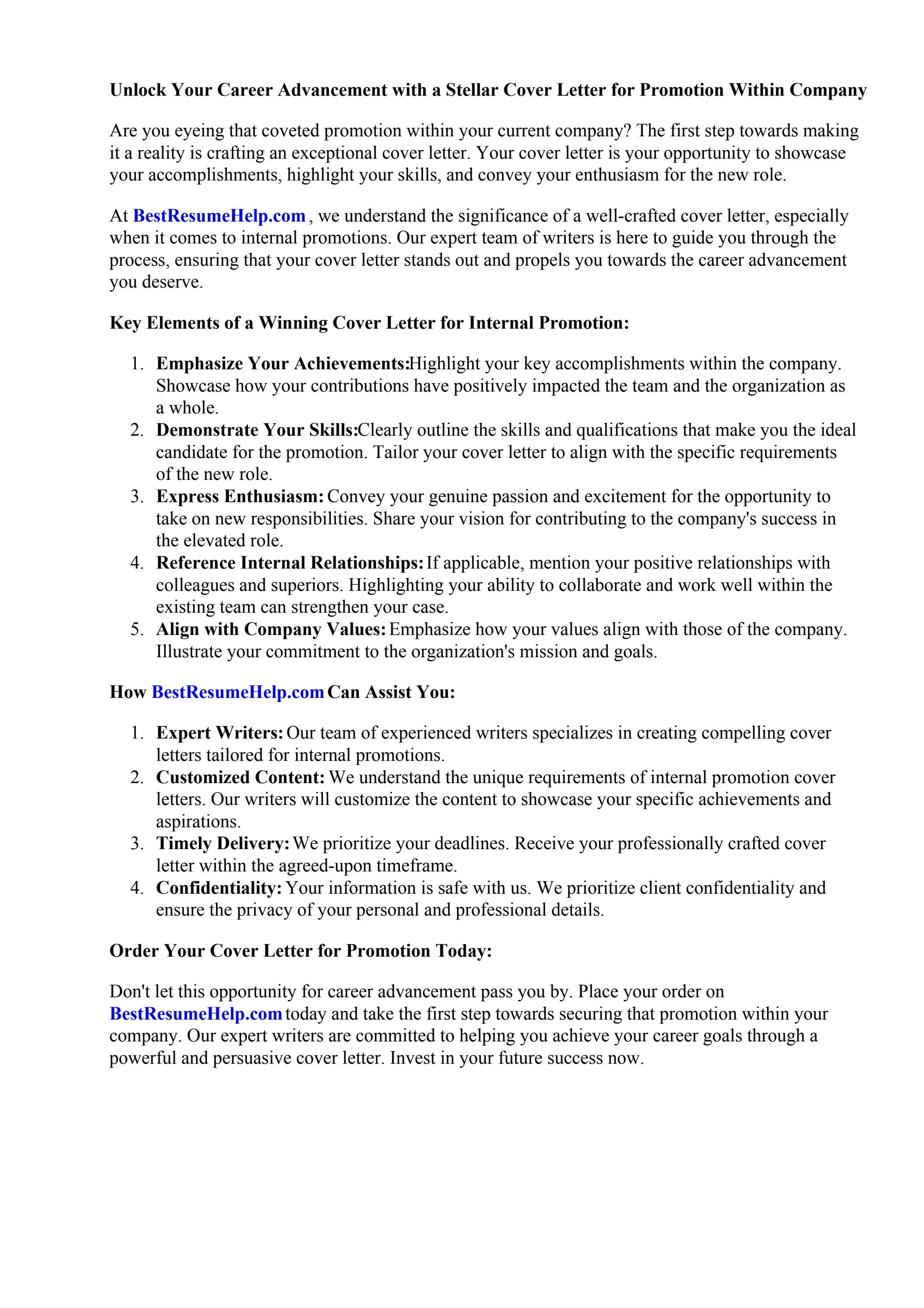
Crafting a Promotion Cover Letter
A promotion cover letter is a crucial document when aiming to advance within your current company. It’s your chance to demonstrate to your superiors that you are the ideal candidate for the role, highlighting your skills, accomplishments, and enthusiasm for the new position. Unlike a general job application, this letter should focus on your internal knowledge and the contributions you’ve already made within the organization. It’s about showcasing your understanding of the company’s values, your dedication, and your proven ability to deliver results. The goal is to clearly and concisely present your case, emphasizing why you deserve the promotion and how you will continue to contribute to the company’s success in a new capacity. A well-crafted cover letter can significantly increase your chances of securing the promotion and advancing your career.
Researching the Promotion
Before you start writing, thoroughly research the promotion you are seeking. This involves understanding the new role’s responsibilities, required skills, and reporting structure. Review the job description carefully, paying attention to the key requirements and expectations. This understanding will inform your letter, allowing you to tailor your achievements and skills to match the company’s needs. Demonstrate that you are taking the initiative to succeed in the new position. Understand the challenges and expectations associated with the role. Furthermore, researching the promotion also involves gaining insights into the company’s recent projects, goals, and values. This information can be used to align your cover letter with the company’s priorities, which shows you are not only interested in the promotion but also in contributing to the company’s future success. Knowing your audience, in this case, the hiring manager or your supervisor, is also critical to tailoring your letter accordingly. This research will help you create a compelling and targeted cover letter.
Understanding the New Role

Delving into the specifics of the new role is essential for a compelling cover letter. Start by carefully analyzing the job description to gain a comprehensive understanding of the responsibilities, expectations, and required skills. Consider what skills and knowledge you have that align with the new role. This detailed analysis will guide you in highlighting the most relevant experiences and achievements in your cover letter. Understanding the role also means identifying the key performance indicators (KPIs) that will be used to evaluate your success. Showing that you understand the role’s importance within the organization can help to demonstrate your preparedness and strategic thinking.
Analyzing Your Current Performance
Before writing your cover letter, evaluate your current performance and contributions to the company. Review your past performance reviews, project outcomes, and any commendations you have received. Identify specific instances where you have excelled in your current role, such as successfully leading projects, exceeding targets, or implementing improvements that have benefited the company. Also, think about feedback you have received from supervisors and colleagues. Analyze your strengths and areas where you have demonstrated growth. The goal is to collect evidence of your value to the company. This analysis will serve as the foundation for the examples of your achievements. This will help you illustrate how you can transition into the new role. Include any instances where you have gone beyond your job description to contribute. Be sure to be specific and provide concrete examples.
Highlighting Achievements and Skills
The core of your promotion cover letter should focus on highlighting your achievements and relevant skills. This is your opportunity to showcase your value to the company and demonstrate your readiness for a higher-level position. Start by identifying your key accomplishments in your current role. Quantify your achievements whenever possible, using numbers and data to illustrate your impact. For example, instead of saying ‘Improved customer satisfaction,’ say ‘Improved customer satisfaction by 15%.’ Be sure to align these accomplishments with the requirements of the promotion. Moreover, show how your skills align with the new role. This section is crucial for making a strong case for why you deserve the promotion. The goal is to impress the hiring manager or your supervisor. Therefore, it’s essential to communicate your key achievements effectively.
Quantifying Your Accomplishments

Quantifying your accomplishments is a highly effective way to demonstrate your value to the company. Instead of making general statements about your achievements, use numbers, percentages, and specific data points to show the impact of your work. For example, instead of saying ‘Increased sales,’ state ‘Increased sales by 20% in Q3 2023.’ Similarly, if you improved efficiency, indicate how much time or resources were saved. Using metrics makes your achievements more tangible and convincing. When possible, compare your results to previous periods or industry averages to provide context. For example, ‘Reduced project completion time by 10%, exceeding the industry average of 5%.’ Quantifying your accomplishments helps to set you apart from other candidates. It offers concrete evidence of your skills, dedication, and ability to deliver results, making a stronger case for your promotion.
Showcasing Relevant Skills
Showcasing relevant skills is vital to a promotion cover letter. Review the job description and identify the skills that the new role requires. Then, highlight your skills by providing specific examples of how you have used them in your current position. For each skill, briefly describe the situation, your actions, and the results. This method, often referred to as the STAR method (Situation, Task, Action, Result), helps you provide a clear and concise account of your abilities. Make sure to include both hard skills (technical skills) and soft skills (interpersonal skills), such as leadership, communication, and problem-solving. Tailor your presentation to the specific requirements of the new role. Demonstrating that you possess the skills needed for the promotion will make a strong case for your candidacy.
Tailoring Your Letter to the Job
Tailoring your promotion cover letter is crucial for showcasing your genuine interest. A generic cover letter will not impress the hiring manager or your supervisor. Instead, you should tailor your letter to the specific requirements of the promotion and the company’s culture. Tailor your letter to the specific requirements of the promotion. This involves understanding the key responsibilities, required skills, and expectations of the new role. Review the job description carefully and adjust your content to match these requirements. Moreover, show that you understand the company’s values, goals, and recent projects. Demonstrating your knowledge of the company shows that you are invested in its success. Demonstrate your commitment to the company’s future by highlighting your understanding of its goals and how you will contribute to their achievement.
Addressing Specific Requirements

When tailoring your cover letter, address the specific requirements outlined in the job description. Start by listing the key skills and qualifications the new role demands. Use the job description as a checklist, ensuring you address each requirement. Provide examples of how you have demonstrated these skills in your current role. Refer to specific projects, tasks, and accomplishments that illustrate your abilities. This targeted approach shows the hiring manager that you have carefully reviewed the job description. It also emphasizes that you are the best candidate for the promotion. Avoid generic statements. Instead, tailor your writing. This is essential to creating a compelling and effective cover letter.
Using Keywords Effectively
Incorporating relevant keywords from the job description can significantly improve your cover letter’s effectiveness. Carefully review the job description and identify the key skills, qualifications, and phrases the company uses. Weave these keywords naturally into your cover letter to show that you understand the role’s requirements. Use keywords in your headings, bullet points, and the body of your letter. Remember to maintain a natural tone, avoiding keyword stuffing. The goal is to make your letter easy to read and relevant. By using the right keywords, you can increase your chances of getting your cover letter noticed.
Formatting and Structure
The formatting and structure of your promotion cover letter should be professional and easy to read. A well-formatted letter ensures that the hiring manager can quickly grasp your key qualifications and accomplishments. Use a clear, easy-to-read font, such as Arial or Times New Roman, with a font size between 10 and 12 points. Structure your letter logically, with an introduction, body paragraphs, and a conclusion. Use headings and bullet points to break up large blocks of text and highlight important information. Ensure the letter is well-organized and visually appealing. This will make it easier for the reader to understand your message and appreciate your qualifications.
Opening and Closing Statements

Your opening and closing statements are critical to creating a good first and last impression. Your opening should immediately grab the reader’s attention and state the purpose of your letter. Express your interest in the promotion and mention your current role. Briefly highlight your key qualifications or a significant achievement that makes you an ideal candidate. Your closing should reiterate your interest in the position. Thank the hiring manager for their time and consideration. End with a call to action, such as expressing your availability for an interview. Make sure your opening and closing are concise, professional, and leave a lasting positive impression.
Formatting Tips
To ensure your promotion cover letter is effective, pay attention to formatting details. Use a professional font, such as Arial, Calibri, or Times New Roman, in a size between 10 and 12 points. Maintain consistent spacing throughout the document. Use headings, subheadings, and bullet points to break up the text and make it easier to read. Keep paragraphs concise, typically three to five sentences. Use appropriate margins (1 inch on all sides) and ensure the letter is well-aligned. Proper formatting creates a professional appearance and improves the overall impact of your cover letter. It shows that you pay attention to detail and take pride in your work.
Reviewing and Editing
Before submitting your promotion cover letter, carefully review and edit it. This step is crucial for ensuring your letter is polished and professional. Check for any grammatical errors, spelling mistakes, and punctuation errors. Read the letter aloud to identify awkward phrasing or sentences that could be improved. Also, review your content. Make sure your key qualifications and achievements are clear and well-supported by specific examples. Ensure that your letter flows logically. Consider having someone else review your letter to catch any errors you might have missed. A well-edited cover letter conveys professionalism and increases your chances of getting the promotion.
Proofreading for Errors

Proofreading is a critical step in the writing process. Thoroughly proofread your promotion cover letter for any errors. Check for spelling mistakes, grammatical errors, and punctuation errors. Pay close attention to sentence structure and word choice to ensure clarity and professionalism. It is often helpful to read your letter aloud. This will help you to catch any awkward phrasing or sentences that do not flow smoothly. Consider having a friend or colleague proofread your letter as well. A fresh pair of eyes can often identify errors that you might have missed. A letter free of errors reflects attention to detail and conveys a strong impression.
Seeking Feedback
Seeking feedback from trusted sources is crucial for refining your promotion cover letter. Ask colleagues, supervisors, or career advisors to review your letter and provide constructive criticism. Request specific feedback on the clarity, organization, and impact of your letter. Ask if your achievements are well-presented and if the letter effectively highlights your skills and qualifications. Consider their suggestions and make revisions as needed. A well-received cover letter is a collaborative effort. Gaining feedback from others can help you to identify areas of improvement. Furthermore, getting feedback from others will help you to catch any mistakes you might have missed. This will strengthen your letter.