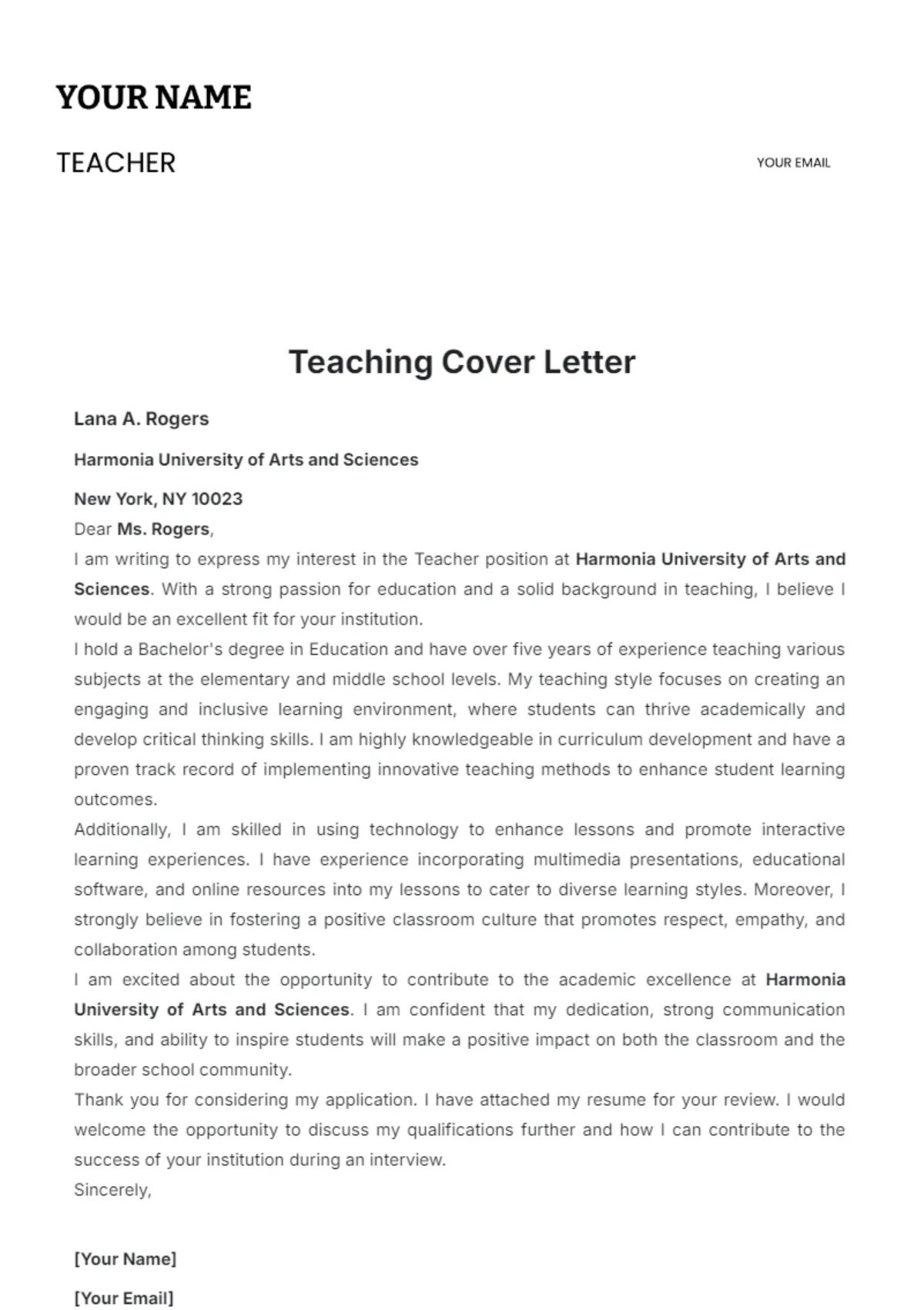
Understanding the Teaching Cover Letter
A teaching cover letter is more than just a formality it is your first chance to make a strong impression on a potential employer. It is your opportunity to introduce yourself, showcase your qualifications, and express your passion for education. Think of it as your personal introduction that can set you apart from other candidates and increase your chances of landing an interview. A well-crafted cover letter complements your resume, providing a detailed view of your personality, teaching philosophy, and the value you bring to the school.
Why a Cover Letter Matters
In a competitive job market, a cover letter can be your most powerful ally. It is your chance to tell a story about yourself that a resume cannot. It offers you a space to personalize your application, demonstrate your understanding of the school’s needs, and express your genuine interest in the specific teaching role. By showcasing your unique qualifications and passion for teaching, a cover letter can significantly boost your application and make you stand out among the crowd. Many hiring managers consider cover letters as a crucial element in their initial assessment, as they offer insight into the applicant’s communication skills and attention to detail.
Highlighting Your Unique Selling Proposition

Your unique selling proposition (USP) is what makes you different from every other teacher applicant. It is essential to identify and highlight your USP to make your cover letter and application more engaging. This could include your specific teaching style, unique skills (such as proficiency in a second language or experience with special needs students), or your personal teaching philosophy. To identify your USP, reflect on your experiences, strengths, and what you are most passionate about when it comes to teaching. Then, explicitly state how these aspects would benefit the school and its students.
Key Components of a Teaching Cover Letter
Crafting a successful teaching cover letter requires a thoughtful approach to include the right elements. Ensure you cover all key components to provide a full picture of your qualifications, experience, and personality. These components, when combined, will increase the likelihood that your application stands out. A well-structured letter highlights your understanding of the position and expresses your enthusiasm to contribute to the school’s mission.
Header and Contact Information
Begin your cover letter with a professional header. Include your full name, address, phone number, and email address. Also, add the date and the hiring manager’s name (if you know it) and the school’s address. This information establishes your professionalism and makes it easy for the school to contact you. Make sure all the information is accurate, updated, and clearly displayed. Consistency across your resume and cover letter enhances your professionalism and makes it easier for the recruiter to follow up.
Personalized Salutation

Address the hiring manager directly whenever possible. Use “Dear Mr./Ms./Mx. [Last Name]” or, if you don’t know the name, use a generic yet respectful salutation like “Dear Hiring Committee” or “Dear [School Name] Principal.” Avoid generic salutations such as “To Whom It May Concern.” Personalizing your salutation shows you have taken the time to research the school and the specific role. This simple step immediately signals your interest in the position and makes your letter more engaging. Using the correct name also demonstrates your attention to detail, which is a critical skill for educators.
Introduction that Captivates
The introduction is your chance to grab the reader’s attention. State the position you are applying for and briefly mention where you saw the job posting. Then, highlight your most relevant qualifications or a key achievement that makes you stand out. This opening should be concise, enthusiastic, and tailored to the specific role. A strong introduction will immediately set the tone and encourage the reader to continue reading. A well-crafted introduction is essential to leave a lasting impression on the hiring committee. The goal is to pique their interest and make them want to learn more about you.
Body Paragraphs to Impress
The body paragraphs are where you showcase your skills, experience, and passion for teaching. Structure your paragraphs to demonstrate your understanding of the role and school’s needs. Use specific examples to illustrate your accomplishments and how you have made a positive impact on students. Focus on using action verbs to highlight your responsibilities and achievements. Provide specific data or metrics whenever possible to quantify your impact. These paragraphs are your opportunity to delve into what makes you the ideal candidate and show how your experiences align with the requirements of the job.
Showcasing Your Skills and Experience

Use this section to highlight how your skills and experience align with the job description. Refer back to the job posting and identify the key skills and qualifications the school is looking for. Provide examples of how you have successfully used these skills in previous roles. Focus on quantifying your achievements whenever possible. For example, instead of saying, “Improved student test scores,” say, “Improved student test scores by 15% within one academic year.” This level of detail shows your ability to deliver results and your commitment to student success.
Demonstrating Your Passion for Teaching
Express your passion for teaching by sharing why you love the profession and what motivates you. Mention your teaching philosophy, and how you approach education. Demonstrate your enthusiasm for creating a positive and engaging learning environment. Talk about any innovative teaching methods you have used or your experiences that have shaped your educational approach. Genuine enthusiasm is contagious and shows that you are dedicated to the role and committed to student success. Share your core beliefs and your vision for how to contribute to the school’s environment.
Aligning with the School’s Values
Show that you understand the school’s values and mission by researching the school’s website, mission statement, and any recent news. Explain how your teaching philosophy and experience align with the school’s goals. Use this section to emphasize why you are a good fit for the school’s culture. Demonstrate your willingness to contribute to the school community beyond teaching, such as through extracurricular activities or mentoring students. Tailor your cover letter to align with the school’s specific goals and demonstrate your interest in contributing to its success.
Compelling Conclusion and Call to Action

End your cover letter with a strong conclusion. Restate your interest in the position and thank the hiring manager for their time and consideration. Include a call to action, such as inviting them to contact you for an interview. Make sure to proofread the conclusion to ensure it reflects your professionalism and leaves a lasting impression. Your conclusion is your final chance to underscore your interest and highlight the value you bring to the school.
Formatting and Proofreading
Attention to detail is paramount when writing a cover letter. Ensuring the correct formatting and careful proofreading demonstrates your professionalism and commitment to excellence. A well-formatted and error-free cover letter shows that you take your application seriously and are capable of producing quality work. The overall presentation significantly impacts how a hiring manager perceives your suitability for the position.
Font and Layout Guidelines
Choose a professional and readable font like Times New Roman, Arial, or Calibri. Use a font size between 10 and 12 points. Maintain consistent formatting throughout the letter, including single-spaced paragraphs with a space between each paragraph. Use clear headings and bullet points to organize your information and make it easy to read. Keep the letter concise, ideally within one page. A well-formatted cover letter enhances readability and helps the hiring manager quickly grasp your key qualifications and experiences.
Proofreading Checklist

Before submitting your cover letter, thoroughly proofread it for any errors. Check for typos, grammatical errors, and inconsistencies in formatting. Use a grammar checker tool and ask a colleague or friend to review the letter. Verify that your contact information is correct and that the letter is tailored to the specific job and school. Ensure your cover letter is free of errors. A polished cover letter shows that you pay attention to detail and take pride in your work. Attention to detail is essential to communicate your professionalism and your commitment to the position.
Tailoring Your Cover Letter for Each Application
Never send a generic cover letter. Tailor each cover letter to the specific job and school. Research the school and the role to understand their needs and priorities. Highlight the skills and experiences that are most relevant to the job description. Tailoring your cover letter shows that you have invested time and effort in your application, demonstrating your interest in the role. This also allows you to directly address the school’s requirements and make it clear that you are the ideal candidate.
Researching the School and the Role
Thoroughly research the school before you begin writing. Visit the school’s website to learn about its mission, values, and programs. Read the job description carefully to understand the specific requirements of the role. Identify the school’s priorities and the qualifications they are seeking in a candidate. Understanding the school’s needs will help you tailor your cover letter to highlight relevant experiences and demonstrate how you can contribute to their goals. Show that you have taken the initiative to learn about the school.
Using Keywords from the Job Description

Incorporate keywords from the job description into your cover letter. Identify the key skills and qualifications the school is looking for and use the same language to describe your experience. This helps the hiring manager quickly see that you possess the necessary qualifications. Use keywords naturally and avoid keyword stuffing, which can make your letter sound unnatural. The use of relevant keywords makes it easy for the hiring manager to evaluate your qualifications. Also, it is useful for applicant tracking systems (ATS), ensuring your application is found.
Common Mistakes to Avoid
Avoid these common mistakes to ensure your cover letter makes a positive impression. Addressing these issues will significantly improve your application and increase your chances of getting hired. Awareness of these pitfalls will allow you to produce a polished and effective cover letter.
Generic Cover Letters
One of the biggest mistakes is sending a generic cover letter that isn’t customized to the specific job or school. These letters lack personalization and fail to show your genuine interest in the role. A generic letter doesn’t address the school’s unique needs and fails to demonstrate your understanding of their mission and values. Ensure you research and tailor your cover letter for each application, highlighting how your skills and experience align with the specific requirements of the role and school.
Typos and Grammatical Errors

Typos and grammatical errors can undermine your credibility and make you appear unprofessional. These errors demonstrate a lack of attention to detail, which is critical for teachers. Before submitting your cover letter, carefully proofread it for any mistakes. Use grammar-checking tools and have a trusted friend or colleague review your letter for a second opinion. A polished, error-free cover letter demonstrates that you are diligent and care about your work.
Ignoring the School’s Needs
Failing to demonstrate an understanding of the school’s needs is a significant mistake. You must research the school’s values, mission, and goals. Then, show how your skills and experience align with those needs. Highlight any experience related to the school’s initiatives or programs. Focusing on the school’s requirements will make your cover letter more relevant and demonstrate your potential to contribute to its success. You must focus on what the school is looking for.